
PRP treatment for hair is the option people start Googling when thinning, shedding, and widening parts stop feeling “normal” and start feeling scary. You’re not imagining it: androgenetic alopecia and other non-scarring hair loss patterns slowly miniaturize follicles over years, turning thick terminal hairs into finer, weaker strands.
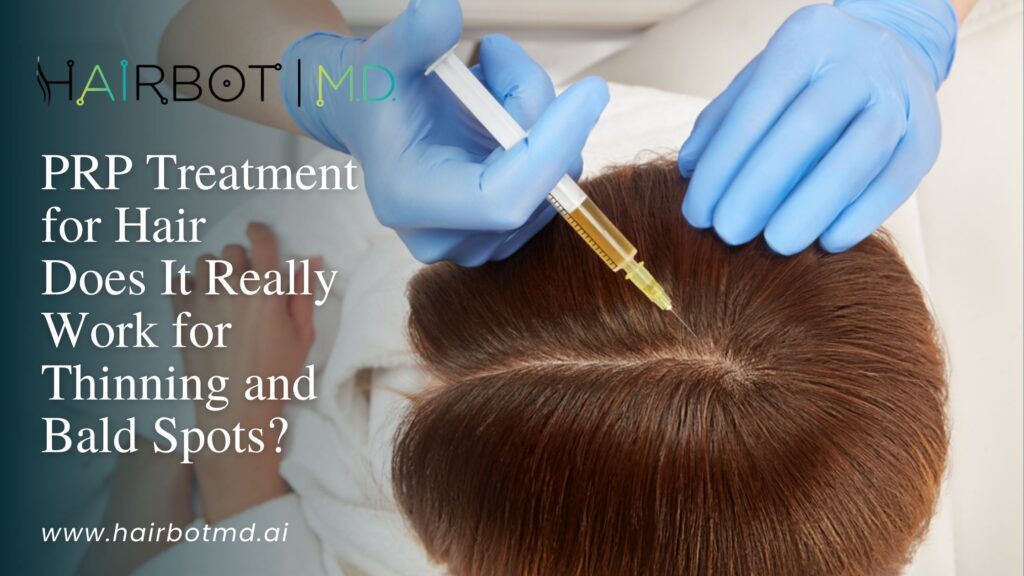
PRP treatment for hair targets that biology directly. Your own blood is drawn, spun in a centrifuge to concentrate platelets, and the resulting growth-factor–rich plasma is injected back into the scalp to stimulate miniaturized follicles and support healthier regrowth.
Clinically, PRP treatment for hair is a minimally invasive, in-office procedure. Dermatologists deliver intradermal or subdermal injections across thinning zones, often pairing them with microneedling to boost growth-factor release and penetration.
The catch?
It’s still an off-label use device that is FDA-cleared for other indications, but not specifically for hair loss, so you need clear counseling about benefits, limits, and unknowns.
That’s why expectations matter. PRP treatment for hair is not a miracle or a transplant replacement; it’s an adjunct that may improve shaft diameter, density, and shedding in the right patient.
HairBot MD closes the loop by letting you log shedding, photos, treatment dates, side effects, and other therapies, so you and your dermatologist can track real progress instead of guessing.
PRP Treatment for Hair – How It Works, What Happens, and Who It’s For
Biological Mechanism and Growth Factor Signaling
At a cellular level, PRP treatment for hair is really a targeted growth-factor delivery system. Your blood is spun to reach platelet levels about two to seven times baseline. Most protocols aim for roughly 1.0–1.5 million platelets per microliter of plasma. That dose matters because platelets carry the bioactive payload driving follicular change.
Key growth factors released from activated platelets include
- PDGF and FGF for dermal papilla proliferation and matrix remodeling.
- VEGF to boost angiogenesis and perifollicular microcirculation.
- EGF, IGF-1, and TGF-β to modulate anagen duration and keratinocyte activity.
Together they
- Accelerate telogen-to-anagen transition in miniaturized follicles.
- Activate ERK and Akt pathways to reduce apoptosis in follicular cells.
- Upregulate β-catenin and Ki67, signaling active cycling and proliferation.
Clinics may use
- Pure PRP or leukocyte-rich PRP, depending on inflammation tolerance.
- DEPA-style thinking around dose, efficiency, purity, and activation.
Protocol variability explains why outcomes in the literature sometimes look noisy and uneven.
Step-by-Step Protocol, Sessions, and Aftercare
In real practice, PRP treatment for hair follows a structured, reproducible workflow.
Baseline workup typically includes
- Global and macro photography for later comparison.
- Trichoscopy to map miniaturization and density.
- Informed consent that actually explains the off-label status.
Procedure steps usually look like this
- Venipuncture with 10–60 milliliters drawn into citrate tubes.
- Single or double centrifugation, depending on the desired platelet enrichment.
- Optional activation with calcium chloride or similar agents.
- Injections are intradermally or as subdermal depots in a grid over thinning zones.
- Optional microneedling passes to enhance growth-factor diffusion.
Typical planning patterns
- Three monthly induction sessions, then spacing every three to six months.
- Or four to six sessions every two to six weeks, then maintenance only.
Stop maintenance, and benefits gradually drift back toward baseline.
Aftercare usually involves
- Avoid heavy exercise, saunas, and harsh chemicals for forty-eight hours.
- Expecting short-lived tenderness, edema, erythema, or mild pruritus.
HairBot MD can ping you at Day 1, Week 2, and Month 3 to log reactions and early changes.
Ideal Candidates, Limits, and Red Flags
The best candidates for PRP treatment for hair share several clinical features. They often have
- Early to moderate androgenetic alopecia, not end-stage baldness.
- Diffuse thinning with visible, viable follicles on trichoscopy.
- Baseline therapy is already optimized with minoxidil and systemic agents.
You should hesitate or avoid in cases of
- Slick, shiny scalp with extensive fibrosis and follicle loss.
- Active scalp disease, including infections, psoriasis, or cutaneous malignancy.
- Platelet disorders, severe anemia, uncontrolled diabetes, or strong immunosuppression.
HairBot MD helps you walk into that consult prepared, not guessing. You can preload family history, triggers, timelines, and photos before any needle touches your scalp.
PRP Treatment for Hair – Clinical Evidence, Risks, and Combination Strategies
What Clinical Studies Show About Density, Thickness, and Shedding
Clinical data on androgenetic alopecia read promising, but not magical. In one major review, seven of nine controlled studies showed measurable benefit. Two trials remained neutral, largely because protocols drifted on dose, spins, and activation methods.
Researchers typically track
- Hair count per square centimeter using standardized phototrichograms.
- Global and regional hair density across frontal, mid-scalp, and vertex zones.
- Anagen-to-telogen ratio and shaft diameter changes under trichoscopy.
- Patient-reported outcomes like styling ease and perceived coverage.
Outcomes vary because several variables keep shifting between trials and patients. Key modulators include
- Platelet dose achieved in the final injectate, not just “PRP done or not.”
- Activation strategy, leukocyte content, and presence of residual erythrocytes.
- Number of sessions, spacing, and accuracy of injection depth and pattern.
- Disease stage, with early miniaturization outperforming long-standing, fibrotic thinning.
For readers, the takeaway stays simple but nuanced.
Think “probable benefit, not guaranteed regrowth,” especially in mixed real-world cohorts. HairBot MD helps you capture hair counts, photos, and shedding logs, so subtle gains stop hiding in memory.
Safety Profile, Side Effects, and Risk Mitigation
Safety remains one of the strongest arguments in favor of this technique. The injectate is autologous plasma, so immunologic reactions and disease transmission risks are extremely low.
Common, self-limited effects include
- Local injection pain or tightness across treated scalp segments.
- Transient edema, erythema, or mild bruising around microinjection sites.
- Short headaches or scalp heaviness for a day or two.
- Occasional temporary telogen effluvium as follicles reset their cycling.
Rare complications demand respect, not panic. These may include
- Local infection where aseptic technique broke down somewhere.
- Exaggerated inflammatory nodules or post-inflammatory scarring in predisposed patients.
- Nerve irritation from overly deep or mis-angled injections.
You reduce risk by choosing a hair-focused dermatologist or restoration surgeon, not a “PRP-only” spa model. HairBot MD can store pre- and post-session photographs, symptom notes, and any adverse events in one longitudinal record.
You and your clinician then adjust technique, intervals, or even decide to discontinue with actual data, not vibes.
Integrating Minoxidil, Finasteride, LLLT, and Surgery
This modality works best as a coadjuvant, not a standalone hero therapy. It does not block dihydrotestosterone or remodel endocrine drivers of miniaturization. Instead, it optimizes the microenvironment and regenerative signaling around vulnerable follicles.
Most specialists recommend continuing
- Topical minoxidil for anagen support and vasodilation, when tolerated.
- Oral finasteride or dutasteride in appropriate male patients, with counseling.
- Spironolactone or other antiandrogens in selected female patients.
Layering additional modalities can create additive or even synergistic outcomes.
Useful combinations include
- Low-level light therapy to enhance mitochondrial activity and microcirculation.
- Nutritional and metabolic optimization when ferritin, vitamin D, or insulin resistance look suboptimal.
- Peri-operative use around hair transplantation to support graft survival and donor healing.
HairBot MD acts like a central “hair operating system” here.
You can track every intervention, dose change, missed application, and procedural date in one timeline. Over six to twelve months, that log helps your dermatologist decide whether to continue, pivot, or retire a protocol.
Ready to make your hair transplant permanent? Schedule your free consultation with HairBot MD and let expert Dr. B guide your transformation.
PRP Treatment for Hair – Closing the Loop
PRP is a biologically plausible, minimally invasive option for scientifically minded patients with thinning zones and early bald spots. It uses autologous platelets, not foreign drugs, to support follicle function, density, and hair-shaft quality over time.
However, it cannot resurrect scarred scalp or fully replace surgical restoration or strong foundational medical therapies. Results arrive slowly, then layer. Most people see meaningful change after several months and only with repeated, well-structured sessions.
When treatment pauses, gains usually soften, then drift back toward the original baseline over time. The smartest play is integration, not isolation.
You fold PRP into a supervised plan that also targets hormones, nutrition, scalp inflammation, and systemic triggers like stress. That ecosystem matters more than any single syringe, no matter how optimized the protocol looks on paper.
HairBot MD turns that complex journey into something measurable, not guesswork and selfies. You log shedding patterns, styling frustrations, concurrent medications, and session timelines in one place.
Then you and your dermatologist decide, with data, whether to start, continue, or stop, and what “success” truly means for you. Small, steady improvements beat dramatic promises every single time.
Redefine Hair Restoration – Advanced Robotic Transplant Solutions at HairBot MD
Step into the future of hair restoration with HairBot MD, your trusted destination for precision-driven robotic hair transplant technology. Our state-of-the-art platform combines cutting-edge robotics with expert medical oversight to deliver natural-looking results with unmatched accuracy and efficiency.
At HairBot MD, we specialize in robotic FUE transplants using systems like ARTAS®, offering minimally invasive procedures, faster recovery, and customized treatment planning. Whether you’re experiencing early-stage hair loss or seeking full restoration, our solutions are designed to meet your unique goals with confidence.
Explore our full range of services and discover how we blend science and artistry to deliver exceptional results. Visit our Home, learn more about our approach, or Contact us to speak with a specialist. Ready to take the first step? Get a Free Assessment today and start your journey to hair confidence.
📍 HairBot MD – Your Destination for Robotic Hair Transplant in Cypress, TX
Looking for the most advanced hair restoration solution near you? HairBot MD specializes in robotic hair transplants using the FDA-cleared ARTAS iX system, delivering precision, speed, and natural results.
✅ Address: 17110 House & Hahl Rd, B-2, Cypress, TX 77433
📞 Call Us: (346) 472-2353
✨ Claim Your Free HairBot MD Assessment!
Whether you’re curious about the ARTAS iX robotic system or ready to schedule a free consultation, our expert team is here to guide you through every step of your hair restoration journey.