
A second hair transplant after 6 months is possible in select cases, but it is not the default timeline in modern hair restoration planning. At HairBot MD, the decision is not based on impatience or a calendar date.
It is based on biology and surgical reality: how the recipient zone is healing, how the donor zone is tolerating extraction, how scalp vascular perfusion is recovering, and whether the first procedure has revealed its true cosmetic yield. Most patients only begin to see meaningful, stable results around 10–12 months, and crown maturation can lag behind that window.
The goal of this guide is to help you decide whether a second hair transplant after 6 months is a safe staged strategy or a rushed revision that increases avoidable risk.
In practical terms, that means distinguishing “planned staging into a new area” from “early repacking into the same recipient zone,” and learning why those two situations behave very differently in terms of graft safety, fibrosis, and density forecasting.
This article is intentionally focused on timing, safety, candidacy, and planning. It does not discuss pricing. It also assumes you already understand core transplant terminology such as FUE/FUT, donor safe zone, graft yield, and shock loss.
Second Hair Transplant After 6 Months – When It Can Be Safe
A second hair transplant after 6 months can be safe, but only when strict clinical criteria are met. The single biggest principle is this: early second sessions are more defensible when they function as controlled staging into appropriate tissue, not as reactive “fixing” before the first session is mature.
Second Hair Transplant After 6 Months in a “Virgin Area” vs Previously Transplanted Zone
A “virgin area” means an untreated recipient scalp that has not undergone prior recipient-site creation or implantation. A previously transplanted zone is tissue that has been through recipient incisions, graft placement, postoperative inflammation, and early remodeling. Those two scalp environments are not equivalent.
A second hair transplant after 6 months is more defensible when the second session targets a virgin zone, for example: a staged crown build after a frontal hairline/mid-scalp session, rather than attempting to repack density into the same area that is still maturing.
Why the difference matters, technically
- Lower risk of transecting immature grafts: In a previously transplanted zone, new site creation must be performed around existing follicles whose direction and depth vary. At 6 months, many grafts are still evolving in caliber and emergence. Precision is harder.
- Less inflammatory overlap: A virgin area has not recently undergone surgical trauma, so the inflammatory burden is lower. That can reduce additive edema, erythema persistence, and early fibrosis load.
- Cleaner site-making geometry around native follicles: Recipient-site creation is a geometry problem, angle, direction, density, and spacing. In a virgin scalp, you have more predictable spacing relative to native follicles. In a recently transplanted zone, you are navigating prior incision patterns and early scar remodeling.
The practical takeaway: Early staging tends to be safer when it is an expansion into a new zone, not density correction in a zone that has not finished declaring its outcome.
Pre-Planned Two-Stage Strategy (Norwood-Scale Logic)
Some patients require multiple sessions by design. This is not “failure.” It is the safer architecture for achieving coverage while protecting the donor area and avoiding aggressive single-session extraction.
A second hair transplant after 6 months may be part of a planned two-stage strategy in cases such as
- Wide bald area / high Norwood patterns: Surface area and cosmetic goals exceed what one conservative session can safely achieve.
- Donor capacity management: Surgeons may split harvesting to avoid concentrated extraction density and reduce the chance of donor patchiness.
- Younger patients with progression risk: Long-term pattern forecasting matters. A conservative first session preserves grafts for future needs.
Key planning constraints that drive staging
- Recipient-area surface coverage vs density packing limits: You can spread grafts for coverage, but density targets must be realistic. Overpacking early can increase trauma and compromise perfusion in tight zones.
- Graft survival considerations: Survival is influenced by graft handling, time out of body, hydration/temperature control, and placement stress. Long, high-volume sessions can increase cumulative stress if not managed expertly.
- Donor “safe zone” mapping and extraction distribution: Donor management is not about a number on paper. It is about distributing extractions across the safe zone to maintain visual integrity and preserve future options.
For the right candidate, staging can be a disciplined way to reach better total aesthetics without exceeding a safe donor extraction pattern in a single day.
Healing + Circulation Benchmarks That Matter
Hair transplantation is a minor surgery, but it still requires tissue recovery. A second hair transplant after 6 months should only be considered when objective healing signals are favorable, not merely when the patient feels “ready.”
Surgeons typically want to see
- Stable wound closure and a normal scar maturation trend: No delayed healing, persistent crusting, or abnormal scarring patterns.
- Normalized erythema/edema patterns: Some redness is normal, but persistent inflammatory signs can signal delayed recovery or overly reactive tissue.
- Recipient skin pliability with reduced tenderness: Tissue that is still tender, stiff, or reactive may not tolerate additional incision density well.
- Donor recovery with no signs of patchiness or overharvesting: The donor must look visually stable, with regrowth patterns consistent with healthy extraction distribution.
- Trichoscopic assessment of donor miniaturization: If the donor zone is miniaturizing, it changes everything. A transplant plan can collapse if the “safe donor” is not truly stable.
HairBot MD’s safety emphasis is simple: The donor is finite and non-regenerative. Repeated harvesting must remain conservative, mapped, and strategically distributed. If the donor is compromised, a second session becomes a risk multiplier rather than an improvement.
Who Should Not Do It Yet
Even if early staging is technically possible, it is not appropriate for everyone. A second hair transplant after 6 months should usually be delayed when the risk profile suggests uncertainty, unstable loss, or donor fragility.
Red-flag profiles include
- Ongoing active shedding (unstable hair loss): If your baseline is actively changing, surgical planning becomes inaccurate. You risk chasing a moving target.
- Poor donor density, donor miniaturization, or prior overharvesting: Donor weakness makes repeat extraction more likely to create visible donor thinning or patchiness.
- Scalp health issues that compromise “enrootment” (graft take): Conditions that reduce tissue quality or healing reliability can lower predictability and increase complication risk.
- Unrealistic density expectations at month 6: At 6 months, many patients are in the “rapid improvement” phase, but the final caliber and density are not fully expressed.
The reason matters: Early intervention can misjudge true yield and push unnecessary graft usage. Once grafts are removed from the donor, you cannot put them back. Timing discipline protects your long-term surgical budget.
Second Hair Transplant After 6 Months – When Waiting 10–12+ Months Is Clinically Smarter
In the majority of cases, waiting is not a delay. It is optimization. A second hair transplant after 6 months may sound efficient, but a 10–12+ month timeline often produces better planning accuracy, safer recipient work, and more rational graft deployment.
Second Hair Transplant After 6 Months vs 10–12 Months – Final Result Visibility and Density Truth
Hair growth after transplantation is staged and nonlinear. You do not get “final truth” at 6 months, especially if your concern is density.
A practical maturation timeline
- Early growth: Typically begins around 3–4 months.
- Major gains: Often occur between 5–9 months as more follicles cycle into visible growth.
- Meaningful assessment: Is usually around 10–12 months for many frontal and mid-scalp cases.
- Crown finalization: May mature later, sometimes closer to 15–18 months, and can lag in both density and swirl-pattern aesthetics.
- Avoids “over-correcting” density too early: At month 6, you can panic and add grafts where they might not be needed once caliber matures.
- Prevents graft waste: Grafts are scarce. Waiting helps target true gaps rather than temporary visual thinness.
- Refines design with real data: Caliber, direction, and coverage become clearer, allowing better micro-design of hairline transitions and crown distribution.
If your motivation is dissatisfaction, the safest strategy is often to wait until the first procedure has fully declared its cosmetic result before choosing the next move.
Second Hair Transplant After 6 Months in the Same Area – The Main Risk Cluster
Early repeat work in the same recipient zone is where risk clusters. A second hair transplant after 6 months becomes substantially more complex if the target is the exact area that was previously transplanted, because you are operating in tissue that is still remodeling.
Risk mechanisms include
- Iatrogenic trauma to newly placed follicles: Recipient-site creation and placement can injure existing grafts, especially when spacing and angle must navigate prior follicles.
- Higher scarring/fibrosis load affecting placement: Early fibrosis can change tissue resistance. This can affect slit creation precision and graft seating.
- Compromised microvascular recovery: Newly remodeled tissue may not yet have optimal perfusion. Perfusion influences healing and graft take.
- Shock loss risk to surrounding native hair: Surgical trauma can push susceptible native follicles into a shedding cycle, especially in areas already under androgen pressure.
This is where technical language becomes practical: Recipient-site creation depends on angle control, depth control, and transection avoidance. When vascular perfusion is still normalizing and fibrosis is evolving, precision becomes harder, and the margin for error narrows.
Donor Management and Long-Term Surgical Budget
Your donor area is your lifetime inventory. A second hair transplant after 6 months should never be planned as if donor supply is unlimited. It is limited, and it does not regenerate.
Core donor principles:
- Safe donor zone is finite: Once follicles are extracted, they do not grow back in the donor.
- Repeated procedures demand strategic conservation: Every additional session uses up reserve and reduces flexibility for repair or future progression.
- Overharvesting is the irreversible complication: Patchiness, see-through donor appearance, and narrowed options for correction.
Planning priorities that reduce repeat-surgery pressure
- Long-term pattern forecasting: Androgenetic alopecia can progress. A good plan anticipates future recession or crown expansion.
- Reserve grafts for repair and future loss: Even excellent surgery benefits from a long-term reserve mindset.
- Combine stabilization therapies when appropriate: Finasteride/minoxidil can help stabilize native hair in suitable candidates, and PRP can be used as an adjunct support to improve hair caliber and reduce shedding pressure.
HairBot MD’s stance is preservation-focused: don’t spend grafts early to fix what time and maturation may naturally improve.
Decision Algorithm HairBot MD Uses
A second hair transplant after 6 months should be a decision you earn through clinical criteria. Here is a simplified decision flow used in strategic planning:
- Confirm diagnosis and stability: Is this androgenetic alopecia with a stable pattern, or is there diffuse instability that needs medical workup first?
- Assess donor density and miniaturization: Use clinical exam and trichoscopy to confirm donor reliability and safe-zone mapping.
- Define the target zone: Is the second session a virgin-area stage or a same-zone density repair?
- Confirm healing and circulation readiness: Evaluate tissue pliability, inflammatory resolution, and donor recovery integrity.
- Decide timing: Approve 6 months only if criteria pass; otherwise, plan 10–12+ months, and longer for crown maturation if needed.
What patients should bring to the consultation
- Standardized photos under consistent lighting and angles
- A clear timeline of shedding, growth, and symptoms
- Documented aftercare adherence (sleep posture, activity limits, washing routine)
- Medication history, supplements, PRP schedule if applicable
That information helps transform the decision from guesswork into a measurable surgical plan.
Ready to reclaim your hair naturally? Book your free assessment at HairBot MD now and discover the advanced hair growth treatment crafted just for you.
Conclusion – Second Hair Transplant After 6 Months – Timing Over Impulse
A second hair transplant after 6 months can be safe only in carefully selected cases, most often when it is part of a staged plan into a virgin zone and when healing, donor integrity, and vascular recovery meet strict benchmarks.
For the majority of patients, waiting until 10–12 months remains the smarter clinical move because it aligns with how transplanted hair actually matures and how density truth is revealed over time. Crown work may deserve even more patience because crown growth and visual blending can finalize later than the frontal zones.
HairBot MD prioritizes donor preservation, data-based planning, and timing discipline because those three factors protect long-term outcomes better than rushing a second session before the first one has fully declared its result.
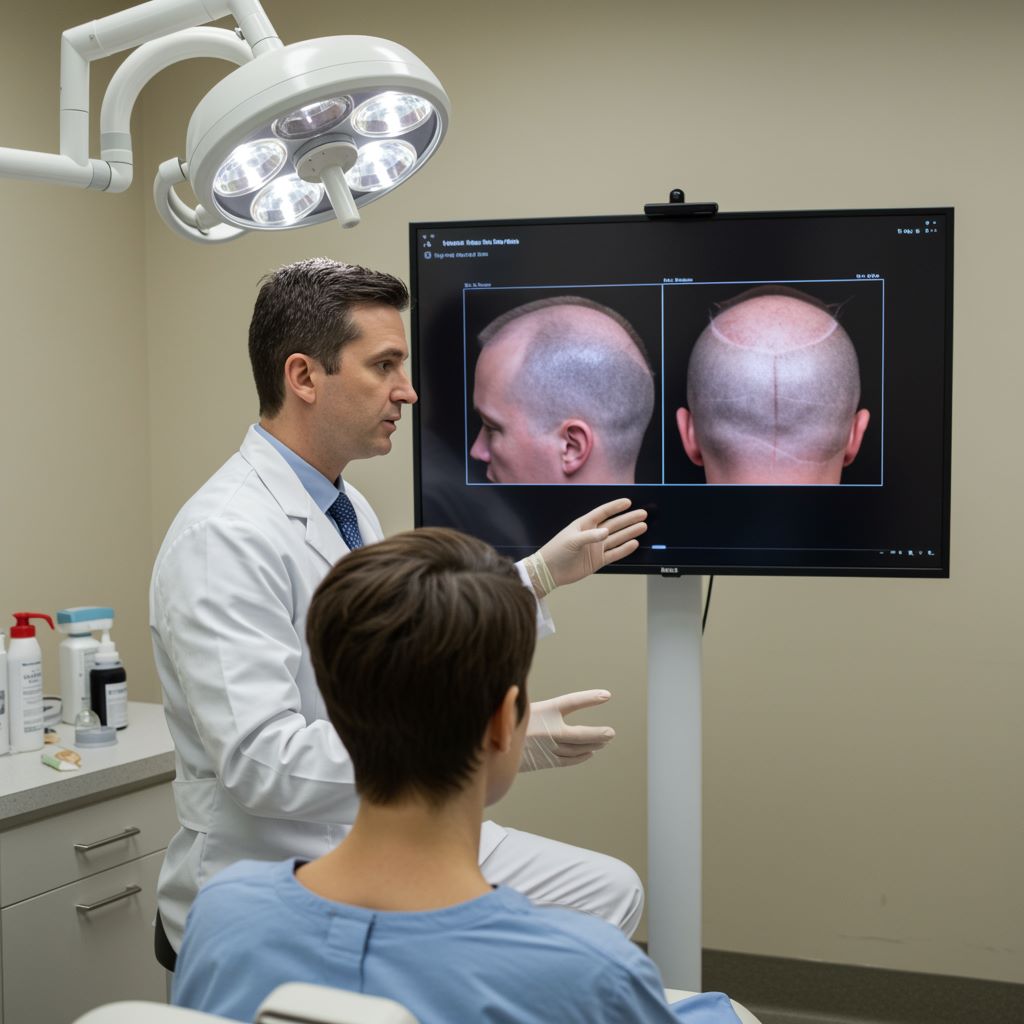
If you are considering a second hair transplant after 6 months, your next step should be a surgical review focused on donor safety, recipient-zone vascular recovery, and realistic density forecasting, not an emotional reaction to early-month appearance shifts.
Redefine Hair Restoration – Advanced Robotic Transplant Solutions at HairBot MD
Step into the future of hair restoration with HairBot MD, your trusted destination for precision-driven robotic hair transplant technology. Our state-of-the-art platform combines cutting-edge robotics with expert medical oversight to deliver natural-looking results with unmatched accuracy and efficiency.
At HairBot MD, we specialize in robotic FUE transplants using systems like ARTAS®, offering minimally invasive procedures, faster recovery, and customized treatment planning. Whether you’re experiencing early-stage hair loss or seeking full restoration, our solutions are designed to meet your unique goals with confidence.
Explore our full range of services and discover how we blend science and artistry to deliver exceptional results. Visit our Home, learn more about our approach, or Contact us to speak with a specialist. Ready to take the first step? Get a Free Assessment today and start your journey to hair confidence.
📍 HairBot MD – Your Destination for Robotic Hair Transplant in Cypress, TX
Looking for the most advanced hair restoration solution near you? HairBot MD specializes in robotic hair transplants using the FDA-cleared ARTAS iX system, delivering precision, speed, and natural results.
✅ Address: 17110 House & Hahl Rd, B-2, Cypress, TX 77433
📞 Call Us: (346) 472-2353
✨ Claim Your Free HairBot MD Assessment!
Whether you’re curious about the ARTAS iX robotic system or ready to schedule a free consultation, our expert team is here to guide you through every step of your hair restoration journey.