
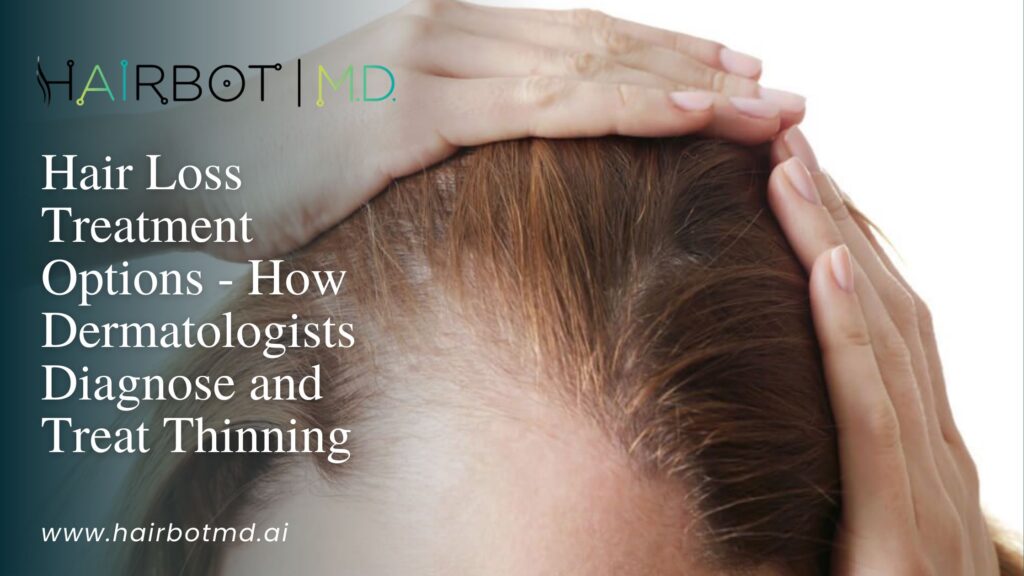
Hair loss treatment options work best when the diagnosis is correct, because “thinning” is not one disease. In clinic, thinning can reflect androgenetic alopecia (follicle miniaturization), telogen effluvium (shedding-cycle shift), alopecia areata (autoimmune follicle targeting), traction alopecia (mechanical pull injury), or inflammatory/scarring pathways that can permanently damage follicles.
Normal shedding still happens during healthy cycling, so dermatology focuses on pattern, timing, follicle survival, and inflammatory scalp signs, not just the amount of hair in the brush.
At HairBot MD, the goal is predictable planning: stabilize native hair first, then choose hair loss treatment options that protect donor supply and long-term cosmetic density.
Hair Loss Treatment Options in Dermatology – Diagnostic Workup That Drives the Plan
A dermatologist doesn’t start with a “best product.” They start with a differential diagnosis and a hair-cycle model. Two patients can both say “my hair is thinning,” yet one has miniaturization and the other has accelerated shedding. The workup is designed to answer three clinical questions that determine hair loss treatment options:
- Are follicles miniaturizing, being immunologically targeted, or just cycling into telogen early?
- Is the process reversible, partially reversible, or scarring?
- Is there a correctable driver (medication, endocrine shift, deficiency, infection, traction, stressor) that must be addressed first?
Hair Loss Treatment Options Start With Pattern Recognition + Trichoscopic Findings
Distribution is the first filter. It narrows the diagnosis before any lab is ordered and prevents random hair loss treatment options.
- Frontal recession + vertex/crown thinning with a stable occipital donor zone supports androgenetic alopecia.
- Diffuse thinning with sudden onset and heavy shed supports telogen effluvium or diffuse alopecia areata.
- Discrete round/oval patches, eyebrow/beard involvement, or rapid patch expansion supports alopecia areata.
- Frontotemporal loss with tight hairstyles, broken hairs, or marginal thinning supports traction alopecia.
- Erythema, scale, pustules, pain/burning, or loss of follicular openings raises scarring alopecia and changes hair loss treatment options urgently.
Trichoscopy (scalp dermoscopy) converts “thin hair” into observable signs:
- Hair shaft diameter variability, increased miniaturized/vellus hairs, and patterned density changes often align with androgenetic alopecia.
- Black dots, cadaver hairs, and exclamation-point hairs suggest alopecia areata activity.
- Perifollicular scale/erythema or reduced follicular ostia can suggest inflammatory/scarring disease and may trigger biopsy before stimulation-focused hair loss treatment options.
Hair Loss Treatment Options Require History, Med Review, and Trigger Timeline
The timeline is a diagnostic tool. Acute shedding after a stressor behaves differently than slow progression over years, and the hair loss treatment options differ.
- Telogen effluvium: Often follows illness, surgery, childbirth, rapid weight loss, severe stress, or medication changes; the typical delay is weeks to a few months.
- Androgenetic alopecia: Slow pattern progression (widening part, reduced ponytail volume, advancing hairline/crown) driven by genetics and androgen sensitivity.
- Alopecia areata: Abrupt patches or diffuse thinning with possible flares/remissions; nails may show pitting.
Medication and supplement review is mandatory because drug-induced shedding and endocrine effects can mimic primary alopecia. Dermatologists also screen for traction habits, chemical processing, heat damage, and scalp inflammation that can alter which hair loss treatment options are safe.
If a patient is using dyes, relaxers, or harsh straighteners, clinicians may recommend pausing them because they can worsen breakage and confuse response tracking.
Hair Loss Treatment Options Get Confirmed with Targeted Testing (When Indicated)
Testing is selective, not automatic, but it prevents months on the wrong hair loss treatment options. Common clinic tools include:
- Hair pull test to assess active shedding.
- Scalp assessment for infection or dermatitis that can drive inflammation-related shedding.
- Labs when clinically indicated: thyroid function, iron status (often ferritin), vitamin D, and other tests based on symptoms or systemic clues.
- Scalp biopsy when scarring/inflammatory alopecia is suspected (because follicles may be at risk of permanent loss).
A useful rule: intact follicles can respond to regrowth-focused hair loss treatment options; destroyed follicles require rapid inflammation control and coverage planning.
“Graft numbers shouldn’t be guesswork. See how HairBot MD calculates density with long-term planning in mind.”
Hair Loss Treatment Options – Evidence-Based Treatments Dermatologists Use for Thinning
Once the subtype is clear, dermatologists build a mechanism-based plan. Most hair loss treatment options need consistent use for months, and results should be judged with standardized photos and objective endpoints, not daily mirror checks. In practice, the strongest plans are layered stabilize progression, stimulate regrowth where possible, then restore coverage or camouflage if needed.
Many patients start with over-the-counter blends (biotin, zinc, collagen, oils, “hair growth” shampoos). These can be reasonable when deficiency is present, but they don’t treat miniaturization or immune attack on their own.
Dermatologists use them selectively, not as the foundation, and they focus first on mechanism-matched hair loss treatment options.
Hair Loss Treatment Options for Pattern Hair Loss (Miniaturization Control)
In androgenetic alopecia, the target is follicle miniaturization. Core hair loss treatment options include:
- Topical minoxidil (commonly 2% or 5%): Supports anagen duration and can increase caliber. Early shedding can occur as cycling shifts; visible change usually requires 3–6 months.
- Oral finasteride (men): Reduces DHT signaling to slow or stop progression; benefits persist only with continued use.
- Combination protocols: Pairing finasteride + minoxidil is common because one stabilizes and the other stimulates.
Technical counseling matters: In miniaturization, “less volume” is often caliber loss, not only shedding. Hair loss treatment options aim to thicken terminal hairs, slow conversion to vellus-like hairs, and maintain donor-dominant zones that future surgical planning depends on.
Hair Loss Treatment Options for Alopecia Areata (Autoimmune Modulation)
Alopecia areata is immune-mediated follicle targeting. Follicles are often capable of regrowth, but the course is unpredictable. Hair loss treatment options commonly include:
- Corticosteroids (topical, oral, or intralesional) to reduce perifollicular inflammation and interrupt immune attack.
- Adjunct minoxidil to support regrowth once inflammation is controlled.
- Phototherapy (e.g., PUVA/UV-based protocols in selected settings) as an additional tool when appropriate.
Patients need relapse-aware expectations: hair can regrow and still shed again later. Monitoring for new patches, eyebrow involvement, and nail changes helps adjust hair loss treatment options early.
Hair Loss Treatment Options That Add Signal – PRP, LLLT, Microneedling
Adjunct therapies can strengthen outcomes when the diagnosis is correct and expectations are realistic.
PRP (platelet-rich plasma) concentrates platelet-derived growth factors and delivers them to the scalp via injection. As hair loss treatment options, PRP is commonly used to support androgenetic alopecia and sometimes as an adjunct in alopecia areata or post-procedure recovery.
LLLT (low-level laser therapy) or photobiomodulation uses red/near-infrared light exposure to support follicle activity. It requires repeated sessions and adherence; improvements are gradual and should be monitored like any other hair loss treatment options plan.
Microneedling creates controlled micro-injury that can enhance topical penetration and trigger wound-healing signaling. In clinical hair loss treatment options plans, it is typically paired with topical therapy and performed with sterile technique and conservative parameters to avoid irritation-driven shedding.
Hair Loss Treatment Options for Coverage: Transplant Strategy + Camouflage
When medical stabilization is in place and loss is stable, coverage-focused hair loss treatment options become relevant:
- Hair transplant (often FUE-based grafting): Relocates resistant donor follicles into thinning zones. Donor safety and pattern stability determine candidacy; diffuse donor miniaturization changes the plan.
- Staged planning: Zones may be treated sequentially (hairline/mid-scalp first, crown later) to preserve donor reserves.
- Scalp micropigmentation (SMP): Reduces scalp–hair contrast to improve the look of density; it is camouflage, not regrowth.
- Hair systems or cosmetic fibers: Useful as temporary cosmetic support while biologic hair loss treatment options take time.
At HairBot MD, planning emphasizes donor preservation and long-term realism: transplant is not a replacement for stabilization hair loss treatment options in progressive patterns, and it should be timed after the diagnosis is stable and expectations match donor limits.
Hair Loss Treatment Options Monitoring – Endpoints, Timelines, and Failure Rules
Monitoring keeps patients from quitting too early or staying on ineffective therapy too long. Dermatologists treat hair as a slow-cycle tissue, so hair loss treatment options are judged on the correct timeline:
- Expect initial signal around 3–6 months for many plans; some zones (especially crown) mature slower.
- Track with standardized photos, consistent lighting, part-width assessment, and symptom logs.
- Watch for adverse effects (scalp irritation, unwanted hair growth, systemic side effects depending on therapy).
- Reduce confounders, limit harsh chemical processing and avoid introducing multiple new products at once.
- Use “failure rules”, if shedding worsens, scalp inflammation appears, or response is absent beyond expected windows, re-check diagnosis, adherence, and triggers.
“Learn what determines whether a hair transplant still looks natural after 10 years and how HairBot MD plans for it.”

Conclusion – Hair Loss Treatment Options That Stay Predictable Long-Term
The best hair loss treatment options are diagnosis-first and mechanism-matched. Dermatologists reduce trial-and-error by separating shedding disorders from miniaturization and autoimmune loss, then layering care: stabilize progression, stimulate where follicles are viable, and add coverage only when donor supply allows.
At HairBot MD, you track standardized photos and symptoms, and you reassess at planned checkpoints instead of reacting to daily shed. Don’t chase products; chase the correct diagnosis. When the mechanism is clear, hair loss treatment options become safer and more predictable for long-term planning.
Redefine Hair Restoration – Advanced Robotic Transplant Solutions at HairBot MD
Step into the future of hair restoration with HairBot MD, your trusted destination for precision-driven robotic hair transplant technology. Our state-of-the-art platform combines cutting-edge robotics with expert medical oversight to deliver natural-looking results with unmatched accuracy and efficiency.
At HairBot MD, we specialize in robotic FUE transplants using systems like ARTAS®, offering minimally invasive procedures, faster recovery, and customized treatment planning. Whether you’re experiencing early-stage hair loss or seeking full restoration, our solutions are designed to meet your unique goals with confidence.
Explore our full range of services and discover how we blend science and artistry to deliver exceptional results. Visit our Home, learn more about our approach, or Contact us to speak with a specialist. Ready to take the first step? Get a Free Assessment today and start your journey to hair confidence.
📍 HairBot MD – Your Destination for Robotic Hair Transplant in Cypress, TX
Looking for the most advanced hair restoration solution near you? HairBot MD specializes in robotic hair transplants using the FDA-cleared ARTAS iX system, delivering precision, speed, and natural results.
✅ Address: 17110 House & Hahl Rd, B-2, Cypress, TX 77433
📞 Call Us: (346) 472-2353
✨ Claim Your Free HairBot MD Assessment!
Whether you’re curious about the ARTAS iX robotic system or ready to schedule a free consultation, our expert team is here to guide you through every step of your hair restoration journey.