
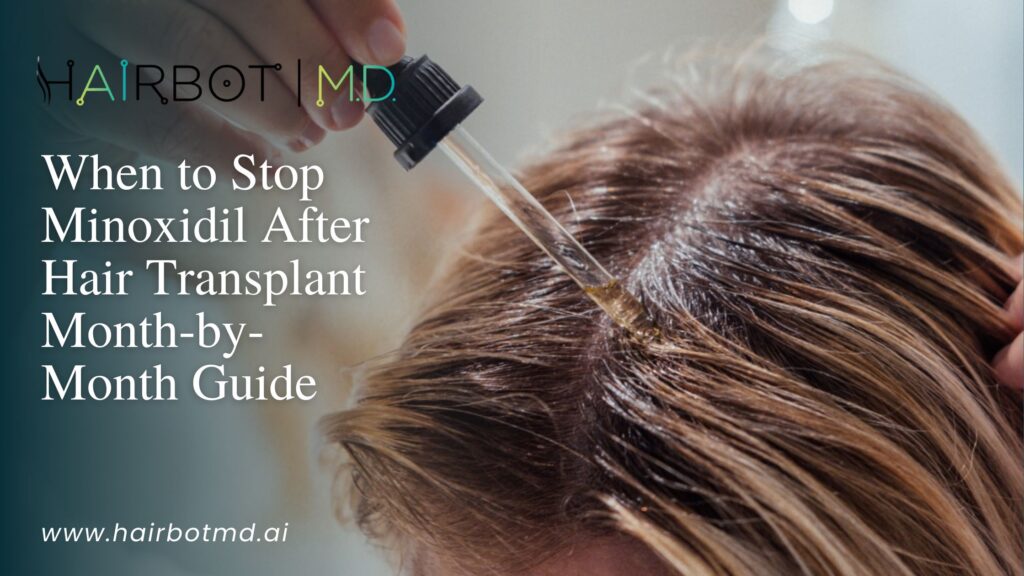
When to stop minoxidil after hair transplant depends on what the medication is protecting: native miniaturizing hair vs newly transplanted grafts. This guide explains how surgeons and dermatologists time minoxidil around healing, shock loss risk, and the slow hair-cycle timeline.
At Hairbot MD, the goal is simple: keep results predictable by stabilizing native hair, preventing avoidable shedding, and only considering when to stop minoxidil after hair transplant once the pattern is stable and the response is measurable. You’ll see why the “stop date” is rarely a single day on the calendar and more of a decision window built on biology, diagnosis, and objective tracking.
Transplanted follicles usually behave differently than your original hair in androgenetic alopecia, so the role of minoxidil can shift after surgery. In some patients it functions like a temporary growth accelerator during the regrowth phase; in others it remains a long-term maintenance tool that keeps surrounding native follicles in anagen longer and slows cosmetic thinning.
The mistake is treating minoxidil like a post-op supplement you automatically discontinue once grafts sprout. The smarter approach is to treat hair as slow-cycle tissue, measure response over months, and avoid confusing normal shedding with failure.
This month-by-month guide is designed to reduce trial-and-error, protect the donor investment, and stop you from either quitting too early or staying on ineffective therapy too long.
When to Stop Minoxidil After Hair Transplant – Month-by-Month Timeline and What Changes
Month 0–1 (Healing Window + Irritation Control)
Month 0–1 is about graft security and scalp barrier recovery, not density gains. In this phase, the recipient area is healing from thousands of micro-incisions, and the donor area is recovering from extraction trauma. Your priorities are vascular stability, edema control, and minimizing friction.
If minoxidil is restarted too early, it can create unnecessary irritation in a scalp that is already inflamed, sensitive, and prone to itching. That irritation matters because friction and scratching increase the risk of folliculitis, dermatitis, and accidental graft trauma.
This is why many clinicians treat month 0–1 as a practical “pause window” for topical minoxidil, especially if the patient has a history of sensitive skin.
Minoxidil formulations may contain alcohol or propylene glycol, which can trigger dryness, burning, and contact dermatitis in some patients. You don’t want to layer that on top of early healing.
What matters most in month 0–1:
- Graft anchoring: Avoid rubbing, aggressive washing, and any application that increases friction.
- Barrier recovery: Control dryness and crusting with surgeon-approved gentle cleansing and moisturization.
- Inflammation control: Swelling is common; minimize triggers that increase redness and itch.
- Irritation risk: Minoxidil can worsen itching and dryness in reactive scalps.
If the scalp becomes red, flaky, intensely itchy, or painful after reintroducing minoxidil, that’s a signal to stop and reassess. When to stop minoxidil after hair transplant in month 0–1 is often less about “stopping forever” and more about preventing irritation-driven setbacks.
Month 1–3 (Shedding Phase + Shock Loss Context)
Month 1–3 is where panic happens because shedding can look dramatic. You may see transplanted hairs fall out, and you may also notice native hair looking thinner. This does not automatically mean the transplant failed. In most cases, this is normal cycling. Transplanted hairs can shed as follicles transition into a rest phase before re-entering anagen. Native hairs can also shed due to surgical stress, anesthesia, inflammation, or the disruption of local scalp physiology.
This is where minoxidil can be misunderstood. Some patients assume that if shedding occurs while using minoxidil, it “isn’t working,” so they stop. Others restart aggressively and then irritate the scalp. Both behaviors create confounders. Dermatology logic is to stabilize the environment and track it.
Clinical interpretation for month 1–3
- Telogen shift is common: Shedding can reflect cycling, not failure.
- Shock loss risk exists: Especially in areas with pre-existing miniaturization.
- Adherence rules matter: Don’t add new actives, oils, peels, or harsh products.
- Tracking is essential: Photos, part-width changes, and symptom logs.
When to stop minoxidil after hair transplant in month 1–3 depends on tolerance and the plan. If you can use it without irritation and your clinician wants it as a native-hair support strategy, it may continue.
If minoxidil triggers dermatitis or makes itching worse, pausing may protect healing more than forcing adherence. Either way, avoid mixing multiple new products, because you won’t know what caused the irritation or shedding.
Month 3–6 (First Signal Window for Response)
Month 3–6 is the first real evaluation window where you can look for “signal,” not just noise. For many medical hair-loss plans, a visible shift often starts around this period.
That doesn’t mean full density, but you should begin seeing early regrowth patterns, improved caliber, or reduced shedding, especially if the diagnosis is androgenetic alopecia and the regimen is consistent.
At this stage, the question isn’t just when to stop minoxidil after hair transplant, it’s whether minoxidil is serving a measurable purpose. If it’s supporting native hair, you may see less progressive thinning around the transplanted zone.
If it’s being used as a growth amplifier, you may see earlier cosmetic improvement, but that still requires months.
What to assess in month 3–6
- Shedding trend: Is it stabilizing or still accelerating?
- Caliber trend: Are shafts thickening, especially in miniaturized zones?
- Coverage trend: Are you seeing early sprouts in the recipient area?
- Scalp tolerance: Any chronic irritation, flaking, or inflammation?
When to stop minoxidil after hair transplant should not be decided here unless you have a clear reason: poor tolerance, clear nonadherence, or a diagnosis that doesn’t benefit. If response is absent beyond expected windows, don’t guess, re-check diagnosis, adherence, triggers, and competing factors like iron deficiency, thyroid disease, or ongoing traction.
Month 6–12 (Decision Window Starts Here)
Month 6–12 is the most practical decision window for “stop vs taper vs maintain,” because graft maturation is more visible and your baseline becomes clearer. Many patients see meaningful growth by this time, but some zones, especially the crown, mature more slowly. That’s why stopping at month 6 based on impatience can be a mistake.
The key clinical logic: Transplanted follicles are usually more resistant to androgen-driven miniaturization, but your native hair is not. If the patient has androgenetic alopecia, stopping minoxidil can unmask progression in non-transplanted areas or in the zones between grafts.
That can create the illusion that the transplant “didn’t last,” when the reality is that native hair continued to miniaturize.
Decision factors in month 6–12
- Hair-loss subtype: Androgenetic alopecia tends to need long-term maintenance.
- Native hair status: Miniaturization around the transplant makes minoxidil more valuable.
- Scalp tolerance: Chronic irritation changes the cost-benefit.
- Patient goals: Some accept maintenance; others prefer minimal long-term therapy.
When to stop minoxidil after hair transplant in this window should be framed as a risk trade. If you stop and native hair begins thinning again, you may need to restart or consider alternative stabilization strategies.
A taper is often more rational than an abrupt stop, because sudden cessation can coincide with a perceived shed and trigger unnecessary anxiety.
After 12 Months (Maintenance vs Discontinuation)
After 12 months, the transplant outcome is usually clearer, and you can judge the role of minoxidil with more confidence. This is where many clinicians separate two groups: patients who used minoxidil as a temporary support tool and patients who need it as a long-term maintenance therapy.
If the patient has ongoing androgenetic alopecia risk, minoxidil functions as maintenance, not “post-op only.” In that scenario, stopping can be like removing the scaffolding that was supporting native density.
If the patient has a stable pattern, minimal miniaturization, excellent donor characteristics, and strong tolerance history, discontinuation can be considered, but it should still be monitored and tapered.
After 12 months, a safe approach includes:
- Objective comparison: Standardized photos and consistent lighting.
- Pattern forecasting: Assess future risk zones beyond the transplant.
- Taper plan: Reduce frequency gradually rather than abruptly.
- Monitoring window: Track for several months after reduction.
When to stop minoxidil after hair transplant after 12 months is a personalized call, but it should still be data-driven. The scalp doesn’t care about motivation. It responds to signals, inflammation, and hormone-driven miniaturization.
“Learn how surgical hairline restoration is planned for natural flow, age-appropriateness, and durability.”
When to Stop Minoxidil After Hair Transplant – Clinical Criteria, Failure Rules, and Safe Off-Ramps
When to Stop Minoxidil After Hair Transplant Depends on What You’re Treating (Grafts vs Native Hair)
This is the core framework: grafts and native hair behave differently. Hair transplant surgery relocates donor follicles that are typically more resistant to DHT-driven miniaturization into thinning zones.
That resistance is why transplants can look stable long-term. But the surrounding native hairs often remain genetically sensitive. So even with a successful transplant, the overall look can degrade if native hair continues to miniaturize.
If diffuse donor miniaturization exists, candidacy and planning change. That same logic applies post-op. If you have diffuse thinning patterns, stopping minoxidil can accelerate loss in areas that were never transplanted or in zones between grafts.
Clinical reasoning that guides when to stop minoxidil after hair transplant:
- Transplanted follicles: Usually more DHT-resistant, not immune to all factors.
- Native follicles: Can continue miniaturizing without maintenance therapy.
- Diffuse patterns: Require caution because stability is less predictable.
- Long-term planning: Protect donor supply and avoid chasing density with repeated surgery.
This is why dermatologists talk about “stabilize first.” A transplant builds cosmetic structure. Maintenance therapies protect the existing tissue around it.
Signs You Should NOT Stop Yet
Stopping too early is a common error because hair changes are slow and patients want immediate proof. If you stop while the cycle is still volatile, you may misinterpret a normal shift as failure and start bouncing between products. That creates noise and makes clinical decisions harder.
Signs you should not stop minoxidil after hair transplant yet:
- Active progression: Widening part, expanding crown thinning, increasing scalp show.
- Ongoing shedding spike: Especially if it correlates with stress, illness, or poor sleep.
- Inconsistent adherence: Missed weeks, sporadic application, frequent product changes.
- Scalp inflammation: Redness, scaling, perifollicular discomfort, burning.
Also, if you’re using minoxidil to protect native hair in androgenetic alopecia, stopping can remove a supportive signal. The result may not show immediately. It often shows gradually as density and caliber fade over months.
When to stop minoxidil after hair transplant should never be based on one bad week. It should be based on pattern and data.
“Failure Rules” That Trigger Reassessment
Monitoring keeps patients from quitting too early or staying on ineffective therapy too long. Dermatologists treat hair as slow-cycle tissue, so hair loss treatment options are judged on the correct timeline. That means you need “failure rules” to decide when to reassess rather than blindly continuing.
Failure rules that trigger reassessment:
- Shedding worsens beyond expected windows rather than stabilizing.
- Scalp inflammation appears or dermatitis develops after starting therapy.
- Response is absent beyond realistic timelines despite verified adherence.
- Confounders exist like new medications, nutritional deficits, thyroid shifts, or traction.
If failure rules trigger, the next step is not random switching. It’s diagnosis confirmation: differentiate androgenetic alopecia from telogen effluvium, alopecia areata, traction alopecia, or scarring pathways. In other words, you don’t decide when to stop minoxidil after hair transplant until you confirm what you’re treating.
Taper Plan and Monitoring Protocol
If you and your clinician decide to discontinue, tapering is safer than abrupt cessation. A step-down plan reduces perceived rebound shedding and gives you clearer feedback. It also helps control anxiety-driven overreaction, which is common in hair patients.
A practical taper protocol
- Step down frequency gradually (for example, reduce days per week rather than stop overnight).
- Hold each step for several weeks so the cycle has time to show a trend.
- Track systematically: Same lighting, same angle photos, consistent part lines.
- Reduce confounders: Avoid harsh chemical processing and don’t add new actives.
If shedding spikes during taper, don’t automatically label it failure. Compare it against the timeline and your baseline. If the trend persists beyond an expected adjustment window, re-check diagnosis and consider resuming or adjusting the plan.
When to stop minoxidil after hair transplant should feel boring and controlled. If it feels chaotic, your monitoring system is missing.
“Not sure which hair growth treatment fits your diagnosis? Schedule a HairBot MD consultation for a tailored plan.”

When to Stop Minoxidil After Hair Transplant – The Hairbot MD Decision Framework
When to stop minoxidil after hair transplant is not a fixed date, it’s a diagnosis-first, stability-based decision built on slow-cycle biology. At Hairbot MD, the framework starts with separating what you’re protecting: transplanted grafts that typically resist DHT-driven miniaturization versus native hair that can still miniaturize and thin around your new density.
The month-by-month logic matters because early phases are dominated by healing and cycling shifts, not cosmetic proof. Month 0–1 focuses on barrier recovery and minimizing irritation that can amplify inflammation.
Month 1–3 often includes shedding that reflects telogen shift and shock loss dynamics, so stopping out of fear can create more noise than clarity. Month 3–6 is the first reasonable signal window for many regimens, where reduced shedding and caliber improvement can start showing if adherence is consistent.
Month 6–12 becomes the decision window where graft maturation is more obvious and the role of minoxidil can be judged in context: maintenance for ongoing pattern loss versus optional support for select patients.
After 12 months, discontinuation can be considered only when pattern stability is clear, tolerance is good, and objective tracking supports the decision.
The safest method is tapering with standardized monitoring, using failure rules to trigger reassessment rather than impulsive switching. In short, when to stop minoxidil after hair transplant is decided by stability, not impatience, because protecting long-term density is the real goal.
Redefine Hair Restoration – Advanced Robotic Transplant Solutions at HairBot MD
Step into the future of hair restoration with HairBot MD, your trusted destination for precision-driven robotic hair transplant technology. Our state-of-the-art platform combines cutting-edge robotics with expert medical oversight to deliver natural-looking results with unmatched accuracy and efficiency.
At HairBot MD, we specialize in robotic FUE transplants using systems like ARTAS®, offering minimally invasive procedures, faster recovery, and customized treatment planning. Whether you’re experiencing early-stage hair loss or seeking full restoration, our solutions are designed to meet your unique goals with confidence.
Explore our full range of services and discover how we blend science and artistry to deliver exceptional results. Visit our Home, learn more about our approach, or Contact us to speak with a specialist. Ready to take the first step? Get a Free Assessment today and start your journey to hair confidence.
📍 HairBot MD – Your Destination for Robotic Hair Transplant in Cypress, TX
Looking for the most advanced hair restoration solution near you? HairBot MD specializes in robotic hair transplants using the FDA-cleared ARTAS iX system, delivering precision, speed, and natural results.
✅ Address: 17110 House & Hahl Rd, B-2, Cypress, TX 77433
📞 Call Us: (346) 472-2353
✨ Claim Your Free HairBot MD Assessment!
Whether you’re curious about the ARTAS iX robotic system or ready to schedule a free consultation, our expert team is here to guide you through every step of your hair restoration journey.