
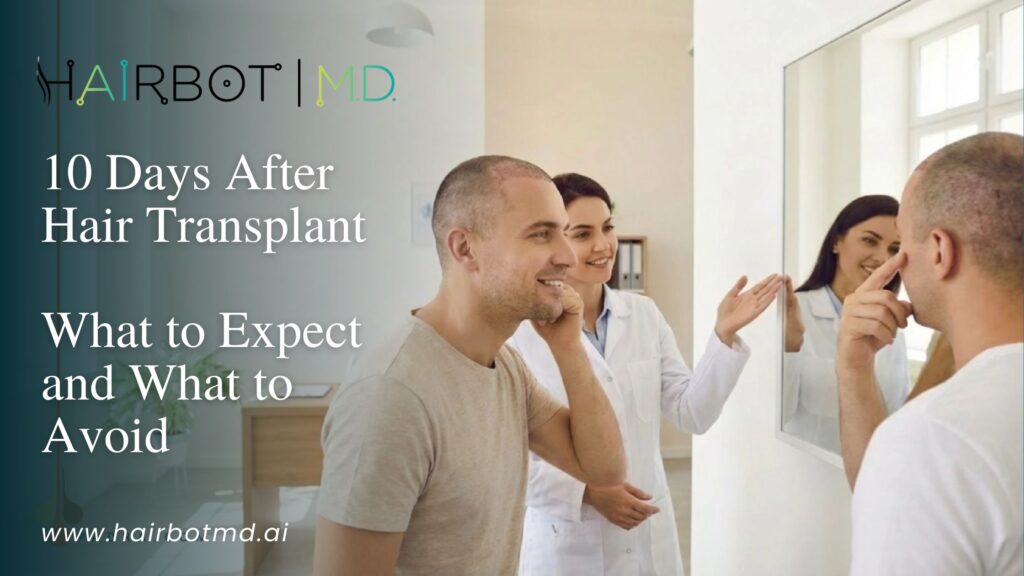
At 10 days after hair transplant, most patients feel a psychological shift: you look more “normal,” discomfort drops, and you want your routine back. Clinically, though, 10 days after a hair transplant is a milestone, not a finish line.
It marks the transition from pure graft protection into early biological stabilization. That matters because the scalp may look calmer while the follicles are still completing tissue integration beneath the surface.
In practical terms, 10 days after a hair transplant is when epithelialization (surface closure) is typically near completion, and crusting should be close to resolving, especially if you followed a structured wash protocol. But “closed skin” is not the same thing as “fully healed.”
Early anchoring has usually occurred, yet full graft fixation and remodeling are still in progress. This is why premature confidence 10 days after hair transplant can still cause avoidable setbacks, usually from friction, sun exposure, sweating, harsh washing, or returning to gym intensity too soon.
This guide explains what HairBot MD wants you to track 10 days after a hair transplant: graft security status, scab/crust management, normal vs abnormal symptoms, and the activity, washing, and lifestyle rules that protect results.
The tone here is physician-led and protocol-driven, because outcomes don’t improve with guessing. They improve when you respect biology and follow a disciplined recovery system 10 days after a hair transplant.
10 Days After Hair Transplant – What to Expect Clinically
Graft Security and Follicular Anchoring
At 10 days after hair transplant, grafts are typically past the most fragile window, but you need to understand what “secure” truly means. There are two layers of stability:
- Mechanical stability: The graft is seated and not easily displaced by light contact.
- Biological integration: The follicle is connecting with the surrounding tissue and microcirculation through wound remodeling.
At 10 days after hair transplant, grafts are more stable but not fully healed, so trauma, friction, and inflammation can still compromise results despite scab removal.
FUE vs FUT nuance
- With FUE, donor sites often show mild pink stippling that fades gradually; discomfort can linger as tightness or sensitivity.
- With FUT, staple or suture removal often occurs around this time, depending on protocol, and the linear incision may still feel tight.
Either way, 10 days after a hair transplant is not the moment to test limits; it’s the moment to normalize safely.
Scabs, Crusts, and the Day-10 Final Wash
Scabs exist for a reason: they’re part of wound healing and protect micro-incisions while the epidermis repairs. At 10 days after hair transplant, scabbing should be significantly reduced, and many patients are ready for a controlled “final wash” process to clear remaining crusts.
Why do clinics push scab removal around 10 days after a hair transplant? Because retained crusts can:
- Trap debris and oils,
- Increase localized inflammation,
- Interfere with healthy follicle emergence,
- Contribute to irritation that triggers scratching.
A typical day-10/day-11 wash logic follows a staged approach:
Softening phase (lotion/foam)
- Apply a moisturizer/foam/lotion to the recipient and donor areas.
- Leave it on long enough to soften crusts (often 15–30 minutes, depending on your clinic).
Gentle wash phase
- Use lukewarm water.
- Lather shampoo in hands first and press/pat it onto the scalp.
- Rinse thoroughly without high-pressure shower streams.
Controlled circular massage (only when cleared by protocol)
- If your clinic permits a day-10 final wash technique, circular motions can help release softened scabs.
- This should be firm enough to lift crusts, but not aggressive enough to irritate skin or cause bleeding.
When to delay scab removal
Not every scalp is identical 10 days after a hair transplant. If you have thick clots, adherent scabs, or areas that look overly inflamed, forcing crusts off can be a mistake. In those cases, you soften longer and progress more slowly rather than “scrubbing to finish.” The goal is clean healing, not speed.
Redness, Sensation, and Inflammatory Signals
Expect some redness 10 days after hair transplant, particularly along the hairline and in lighter skin types. The key is to separate expected erythema from pathological redness.
Normal patterns 10 days after hair transplant include:
- Faint pinkness in recipient zones,
- Mild donor stippling (FUE),
- Residual tightness or tenderness,
- Numbness or tingling as nerves settle,
- Itchiness as neurocutaneous recovery continues.
Itching is common 10 days after a hair transplant, but scratching is still a risk behavior. It’s not just about dislodging grafts; it’s also about triggering micro-trauma that increases inflammation and prolongs redness. If itching spikes, your safer options include hydration measures approved by your clinic (saline misting, foam moisturizers, antihistamines if permitted).
Skin-type variability matters. Patients with fair skin may stay pink longer, while darker skin types may appear less red but still be healing internally. Don’t use appearance alone as the only signal.
Red flags that deserve clinic contact
Use this checklist if something feels “off” 10 days after hair transplant:
- Increasing pain after it had improved
- Warmth, spreading redness, or tender swelling
- Pus-like discharge or foul smell
- Fever or systemic fatigue
- Clusters of pimples with white heads in transplant zones (possible folliculitis)
Early Shedding vs Graft Loss
A stressful moment 10 days after a hair transplant is noticing hair falling out. This often reflects early shedding physiology, not transplant failure. Here’s the core mechanism: Transplantation can push follicles into a temporary resting phase (telogen), and the hair shafts shed while the follicle remains alive under the skin.
Think in terms of two different events
- Hair shaft shedding: Common, expected, temporary
- Graft loss: Uncommon at this stage if you followed care rules, usually linked to trauma or infection
What helps you differentiate visually?
- Short hair shafts coming out without tissue attached
- No bleeding
- Scalp looks stable, not cratered or open
Possible dislodgement signs:
- Bleeding at the same spot
- “Empty” looking pits with fresh redness
- Tissue attached to the hair with a bulb-like structure
- Sudden localized gap after a friction event
Folliculitis/infection pattern:
- Tender bumps
- Pustules
- Increased redness with irritation
At 10 days after hair transplant, the most useful mindset is this: shedding is expected; inflammation is the enemy; trauma is preventable. Your job is to keep the environment calm so the follicles can enter growth cycles on schedule.
10 Days After Hair Transplant – What to Avoid to Protect Results
Activities and Physical Stress to Avoid
At 10 days after a hair transplant, you can often expand activity, but you should do it intelligently. The biggest risks are sweat, blood pressure spikes, and mechanical shear forces.
Exercise hierarchy
- Usually okay: Light walking, low-sweat movement
- Approach cautiously: Moderate activity that raises heart rate but avoids heavy strain
- Avoid until cleared: Heavy lifting, intense cardio intervals, contact sports, anything that forces head-down positions or helmet pressure
Sweat matters 10 days after a hair transplant because salt + friction can trigger itching, rubbing, and irritation. Blood pressure spikes can increase redness and prolong inflammatory signals. If you return to exercise, do it with discipline: shorter sessions, lower intensity, and immediate cleansing afterward.
Work considerations
- Desk jobs are often manageable earlier,
- Manual labor or dusty environments increase contamination risk,
- Jobs requiring helmets or tight headgear should be delayed unless your surgeon clears it.
Travel caveats
- Dehydration increases irritation,
- Friction from headrests and long sitting can be an issue.
- Long flights can worsen swelling in some patients; ask your surgeon if you had extensive work.
Washing, Grooming, and Product Restrictions
Washing usually becomes easier 10 days after a hair transplant, but “easier” doesn’t mean “normal like before.” Your transition should be controlled.
Key rules that protect graft and skin quality:
- Use lukewarm water, not hot.
- Avoid high-pressure shower streams directly on recipient zones.
- Do not use nails. Use fingertips/palms with controlled pressure.
- Rinse thoroughly to avoid residue-induced irritation.
Why towels and dryers remain restricted
A towel introduces friction; a hair dryer introduces heat and airflow shear. Both can prolong redness and trigger itching 10 days after a hair transplant. If you must dry, pat gently or air dry.
Shampoo chemistry matters
Choose products that reduce irritation potential:
- Avoid heavy fragrance,
- Avoid harsh sulfates if your scalp is reactive,
- Avoid silicone-heavy styling products early because buildup can irritate healing skin.
If you’re unsure, a gentle medical or baby shampoo is often used in early protocols. The goal is a stable scalp environment 10 days after hair transplant, not cosmetic perfection.
Sun, Hats, and Environmental Exposure
Sun exposure is a silent risk 10 days after a hair transplant because UV can intensify inflammation, prolong redness, and increase sensitivity. Even if you feel fine, healing tissue behaves differently.
Headwear rules are simple but strict
- Choose loose-fitting, breathable hats if allowed by your surgeon.
- Avoid tight caps that compress the hairline or create friction on graft zones.
- Keep headwear clean; dirty fabric increases infection risk.
Environmental exposure matters too
- Dust, pollution, and smoke can irritate healing skin,
- Construction areas and gyms can increase microbial exposure,
- Avoid direct sunlight as a default, especially in peak hours.
Substances That Delay Healing
If you want an optimal yield 10 days after a hair transplant, avoid the classic healing disruptors:
- Alcohol: Can increase vasodilation, worsen swelling, and disrupt sleep quality, which affects recovery.
- Smoking: Reduces oxygen delivery and compromises microvascular function, bad for follicles trying to stabilize.
- Medication noncompliance: Skipping antibiotics or anti-inflammatories early can allow minor issues to escalate.
If your protocol includes adjuncts like minoxidil or finasteride, timing varies by clinic. The key at 10 days after hair transplant is not to start using products aggressively. Start only when the scalp barrier is sufficiently healed, and your surgeon approves.
“Think you might not be a candidate? Let us show you the facts – book your free assessment now to find out your personalized hair restoration options.”
Final Thoughts About 10 Days After Hair Transplant – Why This Milestone Still Requires Discipline
At 10 days after hair transplant, you’re typically leaving the highest-risk zone, but you are not leaving recovery. This milestone is best understood as the end of the early danger phase, not the end of the process.
Yes, grafts are generally secure 10 days after a hair transplant if you follow protocol. But many long-term disappointments begin with week-2 mistakes: aggressive washing, gym intensity, sun exposure, scratching, or “testing” hats and helmets too early.
HairBot MD treats restoration as reconstructive medicine. That means precision, patience, and compliance are part of the procedure, not optional extras. If you stay disciplined 10 days after hair transplant, you preserve graft viability, reduce inflammation-driven setbacks, and create the calm biological conditions follicles need to cycle into real growth.
Trust biology. Respect timelines. Protect donor and recipient integrity. Your result isn’t built on day 10 hype, it’s built on day 10 discipline, 10 days after a hair transplant.
Redefine Hair Restoration – Advanced Robotic Transplant Solutions at HairBot MD
Step into the future of hair restoration with HairBot MD, your trusted destination for precision-driven robotic hair transplant technology. Our state-of-the-art platform combines cutting-edge robotics with expert medical oversight to deliver natural-looking results with unmatched accuracy and efficiency.
At HairBot MD, we specialize in robotic FUE transplants using systems like ARTAS®, offering minimally invasive procedures, faster recovery, and customized treatment planning. Whether you’re experiencing early-stage hair loss or seeking full restoration, our solutions are designed to meet your unique goals with confidence.
Explore our full range of services and discover how we blend science and artistry to deliver exceptional results. Visit our Home, learn more about our approach, or Contact us to speak with a specialist. Ready to take the first step? Get a Free Assessment today and start your journey to hair confidence.
📍 HairBot MD – Your Destination for Robotic Hair Transplant in Cypress, TX
Looking for the most advanced hair restoration solution near you? HairBot MD specializes in robotic hair transplants using the FDA-cleared ARTAS iX system, delivering precision, speed, and natural results.
✅ Address: 17110 House & Hahl Rd, B-2, Cypress, TX 77433
📞 Call Us: (346) 472-2353
✨ Claim Your Free HairBot MD Assessment!
Whether you’re curious about the ARTAS iX robotic system or ready to schedule a free consultation, our expert team is here to guide you through every step of your hair restoration journey.