
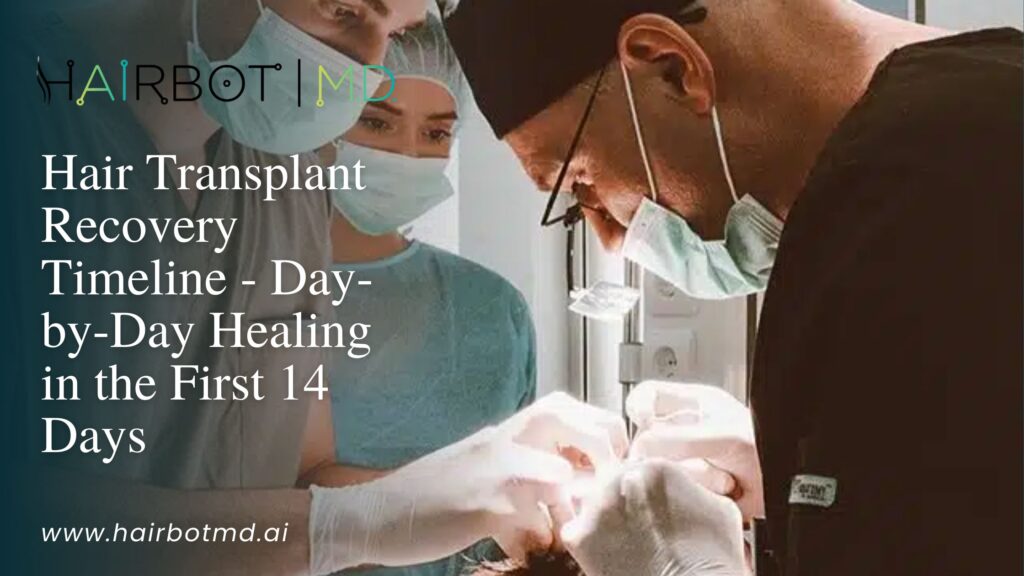
The hair transplant recovery timeline starts the moment graft placement ends. The first 14 days of the hair transplant recovery timeline are the biologic stabilization phase, where fibrin anchoring, epithelial closure, edema control, and donor re-epithelialization decide how many follicles survive.
At HairBot MD, the hair transplant recovery timeline is handled as postoperative tissue management. Patients do best when they know what’s normal, what’s risky, and what needs a same-day call in the hair transplant recovery timeline. This guide covers the first 14 days with clinical milestones and aftercare.
Hair Transplant Recovery Timeline – Day-by-Day Healing in the First 14 Days
Clinically, this segment of the hair transplant recovery timeline is the Initial Recovery Period (IRP). Your primary objective in the hair transplant recovery timeline is graft protection until the security threshold is reached.
(Days 0–3) – Acute Hemostasis and Inflammation
Days 0–3 of the hair transplant recovery timeline are governed by hemostasis and acute inflammation. Recipient sites form micro-clots, donor punch sites seal, and tissue perfusion normalizes as anesthetic effects wear off.
What’s happening biologically in the hair transplant recovery timeline (Days 0–3)
- Fibrin matrix forms around each graft in the hair transplant recovery timeline
- Micro-edema develops as vessels leak fluid in the hair transplant recovery timeline
What you may see or feel in the hair transplant recovery timeline (Days 0–3)
- Tight, achy scalp and donor tenderness in the hair transplant recovery timeline
- Forehead swelling that peaks on day 2–3 in the hair transplant recovery timeline
Non-negotiables for the hair transplant recovery timeline (Days 0–3)
- Sleep is elevated by 30–45° during the hair transplant recovery timeline
- No touching, rubbing, or “checking” grafts in the hair transplant recovery timeline
- Avoid bending, heavy lifting, sweating, and hot showers in the hair transplant recovery timeline
Contact your clinic if you have a fever, pus, severe pain, or bleeding that does not stop.
(Days 4–7) – Epithelialization, Crust Control, and Early Anchoring
Days 4–7 of the hair transplant recovery timeline shift toward epithelialization. Micro-crusts form around grafts, and the epidermal barrier rebuilds.
Physiologic shifts in the hair transplant recovery timeline (Days 4–7)
- Crust formation and early keratinization in the hair transplant recovery timeline
- Reduced vascular fragility and less edema in the hair transplant recovery timeline
Typical experiences in the hair transplant recovery timeline (Days 4–7)
- Itching or tingling in the hair transplant recovery timeline
- Donor “sunburn” sensation that fades in the hair transplant recovery timeline
Care priorities in the hair transplant recovery timeline (Days 4–7)
- Use saline hydration if prescribed during the hair transplant recovery timeline
- Follow your surgeon’s washing method during the hair transplant recovery timeline
- Return to desk work only if grafts stay protected in the hair transplant recovery timeline
Avoid scab picking; it converts healing into trauma and raises infection risk.
(Days 8–14) – Mechanical Security Threshold and Controlled Return to Normal
Days 8–14 of the hair transplant recovery timeline are the mechanical security phase. Scabs loosen and shed naturally during the hair transplant recovery timeline; forced removal is an unnecessary risk in the hair transplant recovery timeline.
Benchmarks in the hair transplant recovery timeline (Days 8–14)
- Scabs flake off with controlled washing in the hair transplant recovery timeline
- Redness decreases for many patients in the hair transplant recovery timeline
What “secure” means in the hair transplant recovery timeline
- Routine daily movement is safer in the hair transplant recovery timeline
- Normal showering can resume gradually in the hair transplant recovery timeline
Secure grafts do not guarantee hair shafts stay; shedding weeks 2–8 is common as follicles enter telogen before anagen returns.
Thinking about a second hair transplant after 6 months? Get a physician-led evaluation at HairBot MD and plan your next step with clarity, donor safety, and long-term results in mind.
Hair Transplant Recovery Timeline After Day 14 – What the IRP Sets Up
After day 14, the hair transplant recovery timeline transitions from wound repair to follicle cycling. Many patients experience “shock loss” during the hair transplant recovery timeline between weeks 2 and 8.
By day 14 in the hair transplant recovery timeline, you typically have
- Lower risk of graft loss with normal activity in the hair transplant recovery timeline
- Reduced infection probability if hygiene was consistent in the hair transplant recovery timeline
- A calmer scalp environment that supports regrowth in the hair transplant recovery timeline
What usually follows: dormancy (up to ~3 months), early sprouts (months 3–4), then maturation through months 6–12+.
How to keep the next phases predictable
- Reintroduce exercise gradually; avoid contact sports early
- Use sun avoidance seriously; UV can prolong erythema
- Ask about finasteride/minoxidil timing if appropriate
Experiencing shock loss after an FUE hair transplant? Let HairBot MD assess your shedding pattern, protect graft health, and guide you through the recovery phase with medical clarity.
Conclusion – Hair Transplant Recovery Timeline – Why the First 14 Days Matter Most
The hair transplant recovery timeline is built on early discipline. The first 14 days of the hair transplant recovery timeline protect graft survival, reduce inflammatory complications, and preserve donor integrity before visible growth begins.
At HairBot MD, the hair transplant recovery timeline is supported with physician-led protocols and structured aftercare education. Treat the first two weeks of the hair transplant recovery timeline as graft insurance: low effort, high payoff. Your long-term density depends on what you do now.
Photos help; the hair transplant recovery timeline rewards consistency. In the hair transplant recovery timeline, avoid heat. When unsure, call. The hair transplant recovery timeline favors caution.
Redefine Hair Restoration – Advanced Robotic Transplant Solutions at HairBot MD
Step into the future of hair restoration with HairBot MD, your trusted destination for precision-driven robotic hair transplant technology. Our state-of-the-art platform combines cutting-edge robotics with expert medical oversight to deliver natural-looking results with unmatched accuracy and efficiency.
At HairBot MD, we specialize in robotic FUE transplants using systems like ARTAS®, offering minimally invasive procedures, faster recovery, and customized treatment planning. Whether you’re experiencing early-stage hair loss or seeking full restoration, our solutions are designed to meet your unique goals with confidence.
Explore our full range of services and discover how we blend science and artistry to deliver exceptional results. Visit our Home, learn more about our approach, or Contact us to speak with a specialist. Ready to take the first step? Get a Free Assessment today and start your journey to hair confidence.
📍 HairBot MD – Your Destination for Robotic Hair Transplant in Cypress, TX
Looking for the most advanced hair restoration solution near you? HairBot MD specializes in robotic hair transplants using the FDA-cleared ARTAS iX system, delivering precision, speed, and natural results.
✅ Address: 17110 House & Hahl Rd, B-2, Cypress, TX 77433
📞 Call Us: (346) 472-2353
✨ Claim Your Free HairBot MD Assessment!
Whether you’re curious about the ARTAS iX robotic system or ready to schedule a free consultation, our expert team is here to guide you through every step of your hair restoration journey.