
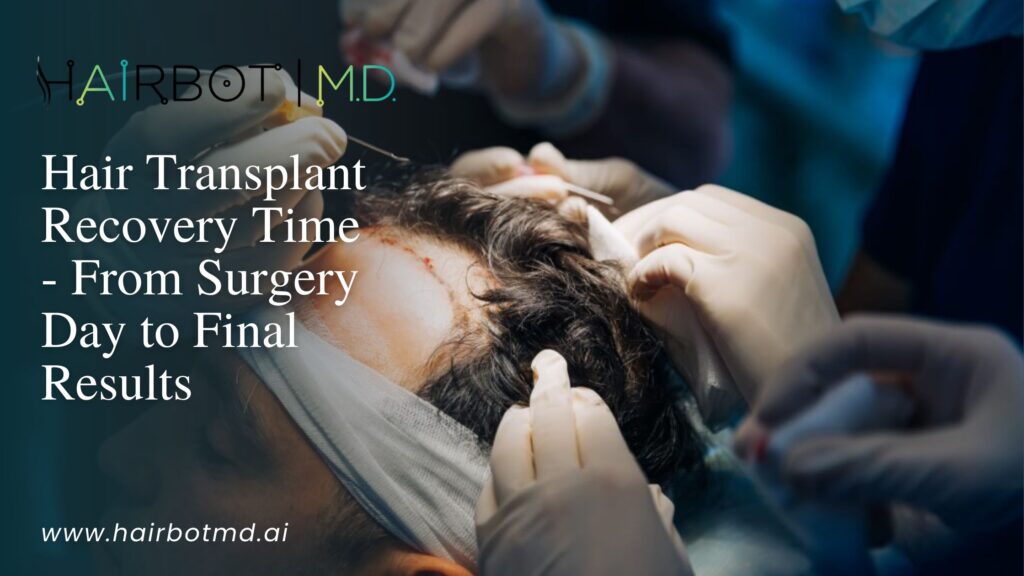
The hair transplant recovery time is not one neat “healed by X day” event. It is a multi-phase biological process that starts the moment graft placement ends and continues until follicles complete cycling and hair shafts mature.
To understand hair transplant recovery time, you need to separate four different clocks that run at the same time: surgical healing time (skin closure and inflammation control), graft stabilization time (when follicular units mechanically anchor and integrate), cosmetic recovery time (when redness, scabbing, and “signs of surgery” fade), and full biological maturation time (when caliber, texture, and density reach their most stable endpoint).
Most patients misunderstand hair transplant recovery time because they judge success only by visible growth. That’s a mistake. Early outcomes are determined by tissue behavior, vascular recovery, epithelial closure, and how well the follicle survives the first weeks—not by hair length.
At HairBot MD, hair transplant recovery time is measured with clinical milestones: inflammation trajectory, graft protection adherence, scab clearance timing, and follicle cycling progression. We don’t treat recovery as cosmetic downtime or calendar shortcuts. We treat it as physiology.
This guide maps hair transplant recovery time from surgery day to final results using predictable healing phases, patient-safe rules, and technical explanations that reduce anxiety and prevent avoidable graft risk.
Hair Transplant Recovery Time – Early Healing and Graft Stabilization Phase
The first weeks are the foundation of hair transplant recovery time. This is when the scalp closes, micro-wounds seal, and follicular units adapt to a new blood supply environment. Early recovery is where you either protect graft survival or create friction-based risk.
If you want the smoothest hair transplant recovery time, treat this phase as a controlled medical protocol, not “rest days.”
(Day 0–7) – Surgical Healing Window
Day 0 to Day 7 is the acute post-operative segment of hair transplant recovery time. The dominant biology here is hemostasis, inflammation, and early reperfusion. In plain terms, your scalp is sealing, stabilizing, and learning how to “accept” new follicular units without excessive trauma.
Key biological processes driving hair transplant recovery time in this window include:
- Hemostasis and clot stabilization: Micro-bleeds seal, and fibrin stabilizes around the recipient sites
- Acute inflammatory response: Controlled swelling recruits repair mediators
- Capillary reperfusion: Tissues re-oxygenate, and microcirculation normalizes
Clinically, this stage of hair transplant recovery time often looks like:
- Swelling patterns: Mild to moderate edema, often peaking around day 2–3
- Erythema: Redness in donor and recipient zones; more visible in lighter skin types
- Micro-crust formation: Tiny scabs around grafts as epithelial sealing progresses
- Donor sensitivity: Tenderness or tightness where extraction occurred (FUE)
A patient’s behavior during this week heavily influences hair transplant recovery time. The most important rules are simple but strict:
- Head elevation: Sleep at 30–45° to reduce dependent swelling and pressure
- Activity restriction: Avoid bending, heavy lifting, sweating, and intense heat exposure
- Zero-contact graft protection: No rubbing, scratching, or friction from hats/helmets
- Hygiene discipline: Follow your clinic’s wash schedule exactly; don’t improvise
What matters most: early hair transplant recovery time is about graft survival, not appearance. The scalp can look “worse” before it looks calm. Redness and crusting are not failure signals. They are normal recovery events when they follow the expected trend: peak early, then gradually settle.
Practical guide logic: if symptoms are stable or improving day by day, your hair transplant recovery time is tracking normally. If symptoms intensify after the early peak, that’s when you pay attention.
(Days 8–14) – Graft Security Threshold
Days 8 to 14 are a major milestone in hair transplant recovery time because this is where mechanical stability improves, and the scalp transitions into a safer handling phase. This does not mean “fully healed.” It means the grafts are generally more secure, and the scalp is closing.
In technical terms, this stage of hair transplant recovery time reflects
- Mechanical graft anchoring: Follicular units embed into the dermal plane more firmly
- Dermal integration: Early tissue remodeling begins around the implanted units
- Epithelial closure: Recipient micro-wounds seal; donor dots continue smoothing
What patients typically notice during this part of hair transplant recovery time
- Scabs begin to loosen and shed naturally with correct washing
- Recipient redness reduces but may persist in fair skin or sensitive scalps
- The donor area feels less tender and looks more uniform
- Itching can increase temporarily due to healing and nerve regeneration
Days 8–14 in hair transplant recovery time mark graft security, not recovery completion, so washing must stay gentle, activity restricted, and later shedding is normal follicle cycling, not graft loss.
Experiencing shock loss after an FUE hair transplant? Let HairBot MD assess your shedding pattern, protect graft health, and guide you through the recovery phase with medical clarity.
Hair Transplant Recovery Time – Shedding, Dormancy, and Visible Regrowth
After the early healing window, patients confuse two types of hair transplant recovery time: healing recovery vs growth recovery. Healing recovery is about skin closure and graft stability. Growth recovery is about follicle cycling and shaft development. You can be fully healed and still see no visible regrowth for weeks. That is normal.
(Weeks 2–8) – Shedding Phase
Weeks 2 to 8 are often the most psychologically difficult segment of hair transplant recovery time because transplanted hair shafts may shed. Clinically, this is expected and usually reflects postoperative cycling changes rather than graft failure.
This phase is commonly explained as:
- Postoperative telogen effluvium: Follicles shift into a resting stage after surgical stress
- Hair shaft loss vs follicular survival: The visible hair falls, but the follicle remains
- Reset phase: The follicle prepares to re-enter anagen (growth) later
Why shedding is “built in” to hair transplant recovery time: the follicle is adapting to a new environment. The body prioritizes wound stability and vascular normalization first, then restarts hair production.
Patient guidance points that stabilize expectations during hair transplant recovery time:
- Shedding does not reset recovery time. It is part of it.
- Lack of shedding does not guarantee better results. Some people shed less visibly.
- Anxiety spikes are common. This is where education beats panic.
A useful clinical mindset: if the scalp is calm, the donor is healing, and there are no signs of infection, shedding is usually a normal event within hair transplant recovery time.
Quick checklist in bullet form (week 2–8)
- Mild itching and dryness can persist
- Redness usually fades, but can linger in some skin types
- Small pimples/folliculitis-like bumps may appear as hairs attempt to emerge
- Hair appearance can temporarily look similar to pre-op before regrowth begins
(Months 3–6) – Early Growth Phase
Months 3 to 6 are when patients start seeing visible progress in hair transplant recovery time, but it can be uneven and slow. Biologically, this is the transition from telogen (rest) into anagen (growth).
What this looks like clinically during hair transplant recovery time
- Fine, thin, hypopigmented hairs begin emerging
- Texture may feel wispy at first
- Density appears patchy because follicles do not cycle in sync
- Hairline often shows earlier visible gains than the crown zones
Why does early growth look inconsistent in hair transplant recovery time
- Follicle cycling is staggered; not every graft “turns on” at the same time
- Caliber lags behind emergence; thin hairs appear first, then thicken later
- Zone variability changes the timeline
Zone-specific variability is a real part of hair transplant recovery time:
- Hairline vs crown: Crown typically matures later, and visual density takes longer
- Scalp vascularity differences: Blood supply patterns and tissue thickness vary across zones
In this stage, patients often ask if they should “do more” to speed hair transplant recovery time. The safer answer is: don’t introduce trauma or harsh products without medical clearance. Support the scalp; don’t challenge it.
Helpful behaviors that support this phase of hair transplant recovery time:
- Keep scalp hygiene consistent with approved products
- Avoid aggressive styling and harsh chemicals early
- Follow your clinic’s guidance on adjuncts (minoxidil/finasteride) if appropriate
- Maintain stable sleep and nutrition; inflammatory stress can worsen shedding perception
(Months 9–15) – Maturation and Final Results
This is where hair transplant recovery time becomes about quality, not just quantity. Many patients have visible growth by 9–12 months, but maturation can continue into 15 months depending on zone, hair characteristics, and individual biology.
Key maturation biology in hair transplant recovery time:
- Hair shaft thickening: Diameter increases, improving density perception
- Caliber normalization: Hair becomes stronger and more consistent
- Texture refinement: Strands feel more like native hair
- Blend improvement: Contrast between transplanted and native hair decreases
A critical concept: “density illusion.” In hair transplant recovery time, small changes in hair diameter can create a dramatic change in perceived fullness. That is why results may keep improving even when you think growth has plateaued.
Clarify two endpoints in hair transplant recovery time:
- Cosmetically complete: Many patients see their major transformation around 9–12 months
- Biologically mature: Refinement can continue through 12–15 months (sometimes longer)
This is also where long-term planning matters. A transplant can be successful while native hair continues to thin. So part of the complete hair transplant recovery time thinking is a maintenance strategy, not just graft outcome.
Thinking about a second hair transplant after 6 months? Get a physician-led evaluation at HairBot MD and plan your next step with clarity, donor safety, and long-term results in mind.
Conclusion – Hair Transplant Recovery Time Is a Process, not a Date
Hair transplant recovery time cannot be reduced to one number because biology does not operate in a single phase. Surgical healing, graft stabilization, shedding, dormancy, regrowth, and shaft maturation are different events with different timelines.
If you judge hair transplant recovery time only by visible hair growth, you’ll misread the process and create unnecessary stress. The smarter approach is to track progression: how swelling resolves, how redness trends, when scabs clear safely, and when follicles cycle back into growth. Those milestones define recovery more accurately than any calendar shortcut.
The staged nature of hair transplant recovery time is predictable when you respect it. Early surgical recovery is about inflammation control and wound closure. Graft stabilization is about protecting follicular units until they anchor.
Shedding and dormancy are about follicle cycling, not failure. Regrowth and maturation are about caliber, density perception, and blend quality.
At HairBot MD, the philosophy is simple: measure hair transplant recovery time by milestones, not impatience. Early discipline prevents complications that delay outcomes. Correct expectations reduce anxiety and stop patients from over-handling the scalp at the worst possible time.
The strongest results come from respecting the full hair transplant recovery time, from surgery day to final follicle maturity, because the result is built on what you protect early.
Redefine Hair Restoration – Advanced Robotic Transplant Solutions at HairBot MD
Step into the future of hair restoration with HairBot MD, your trusted destination for precision-driven robotic hair transplant technology. Our state-of-the-art platform combines cutting-edge robotics with expert medical oversight to deliver natural-looking results with unmatched accuracy and efficiency.
At HairBot MD, we specialize in robotic FUE transplants using systems like ARTAS®, offering minimally invasive procedures, faster recovery, and customized treatment planning. Whether you’re experiencing early-stage hair loss or seeking full restoration, our solutions are designed to meet your unique goals with confidence.
Explore our full range of services and discover how we blend science and artistry to deliver exceptional results. Visit our Home, learn more about our approach, or Contact us to speak with a specialist. Ready to take the first step? Get a Free Assessment today and start your journey to hair confidence.
📍 HairBot MD – Your Destination for Robotic Hair Transplant in Cypress, TX
Looking for the most advanced hair restoration solution near you? HairBot MD specializes in robotic hair transplants using the FDA-cleared ARTAS iX system, delivering precision, speed, and natural results.
✅ Address: 17110 House & Hahl Rd, B-2, Cypress, TX 77433
📞 Call Us: (346) 472-2353
✨ Claim Your Free HairBot MD Assessment!
Whether you’re curious about the ARTAS iX robotic system or ready to schedule a free consultation, our expert team is here to guide you through every step of your hair restoration journey.