 Private Hair Restoration - Cypress, Texas
Hair transplant after 2 months is a biological transition phase, not a cosmetic result phase, and that single distinction prevents most unnecessary panic. At hair transplant after 2 months, the scalp often looks “quiet” on the surface, but the follicles are doing high-value work underneath: stabilizing, completing early remodeling, and preparing to re-enter growth.
The 2-month mark sits inside the telogen dormancy window that commonly follows surgical trauma, which is why hair transplant after 2 months can feel confusing: you feel healed, but you don’t see hair.
Visual assessment alone at hair transplant after 2 months is misleading unless you understand follicular cycling. A transplanted follicular unit can be fully alive, well-vascularized, and stable, while the hair shaft remains absent because the follicle is still in a resting stage.
In other words, hair transplant after 2 months is a checkpoint where biology is ahead of appearance.
Here’s what this guide will do for you at hair transplant after 2 months
- Explain why lack of visible growth is common at hair transplant after 2 months
- Explain what’s happening beneath the scalp at hair transplant after 2 months
- Separate what matters clinically vs what triggers anxiety emotionally at hair transplant after 2 months
- Frame everything through HairBot MD’s physician-led, biology-first recovery logic, so hair transplant after 2 months is interpreted accurately rather than emotionally
Hair Transplant After 2 Months – What’s Biologically Happening Beneath the Scalp
At hair transplant after 2 months, the critical processes are not “sprouting.” They are cycle reset, tissue normalization, and signal recovery. Patients often expect hair transplant after 2 months to look like obvious new hair, but that expectation skips the physiology that must happen first. If you interpret hair transplant after 2 months through a wound-healing and follicle-cycle lens, “no growth yet” becomes normal, predictable, and measurable.
The Telogen Resting Phase
hair transplant after 2 months commonly aligns with a telogen-dominant stage for transplanted follicles. Many grafts shed their initial shafts earlier (often weeks 2–6), then the follicles rest before producing a new anagen hair.
That pattern is why hair transplant after 2 months often shows minimal visible change even when graft survival is excellent.
A key clinical rule at hair transplant after 2 months, graft survival ≠ visible hair emergence. Graft survival means the follicle is intact, perfused, and biologically viable.
Visible emergence requires the follicle to re-enter anagen, build a new shaft, and push it through the epidermis, steps that usually lag behind survival.
Follicular unit behavior post-implantation at hair transplant after 2 months typically follows this sequence:
- Initial anagen interruption: The follicle experiences controlled trauma and exits active growth
- Follicle dormancy (telogen): Metabolic activity shifts down; shaft production pauses
- Reset of growth signaling: Local inflammatory mediators decline, and follicle signaling normalizes before anagen restarts.
This is why hair transplant after 2 months can look “stuck.” It isn’t stuck—it’s cycling. A major misunderstanding at hair transplant after 2 months is assuming that early shedding equals failure. In reality, shedding is often part of the cycle reset, not graft loss.
To interpret shedding correctly at hair transplant after 2 months, focus on mechanics:
- Shed hairs are usually short shafts without tissue attached
- There should be no progressive bleeding or crater-like openings at hair transplant after 2 months
- The scalp should look closed and stable, not raw or actively inflamed
If hair transplant after 2 months is stable, no worsening pain, no spreading redness, no discharge, then “no growth yet” still fits normal physiology.
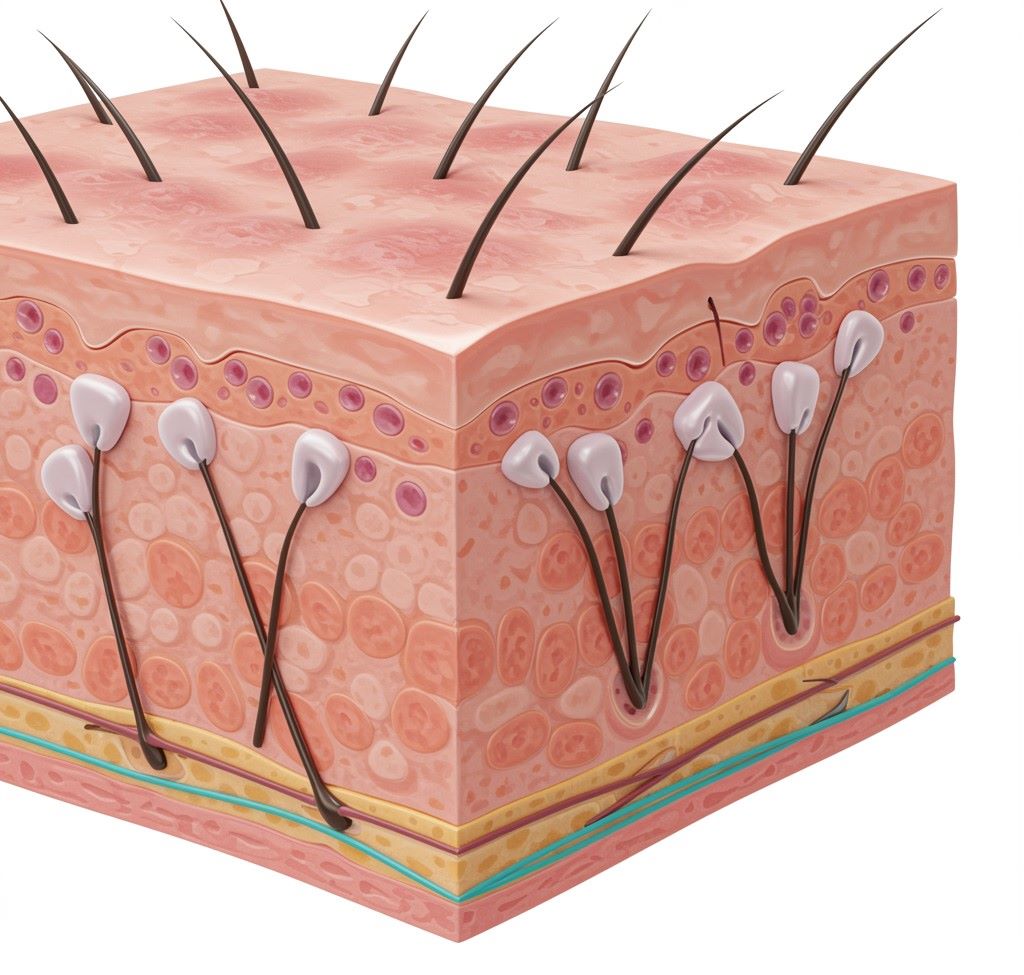
Vascularization and Follicle Reattachment
At hair transplant after 2 months, your result is not being determined by what you can photograph. It’s being determined by what you can’t see: revascularization, oxygen delivery, and follicle reattachment in the dermis.
Early after surgery, grafts survive initially by diffusion; over time, the tissue builds stable microcirculation. By hair transplant after 2 months, the scalp is moving further into remodeling, and the graft environment becomes more “normal” for hair production.
Technically, here’s what matters at hair transplant after 2 months:
- Revascularization: Capillaries integrate around the graft; perfusion becomes more reliable
- Oxygen diffusion efficiency: Improves as inflammation drops and microcirculation stabilizes
- Dermal papilla recovery: The dermal papilla is a signaling center for hair formation; it needs time to normalize after transplantation
- Signaling latency: Even when the graft is healthy, it can take weeks for the follicle to “switch on” shaft production
This is why hair transplant after 2 months can still show a sparse recipient zone. The follicle may be ready internally, but the shaft production timeline still needs to run.
For patients who had robotic FUE, it’s important to understand this at hair transplant after 2 months: ARTAS-harvested FUE grafts still obey biology. Robotic harvesting can improve consistency and donor management, but it does not override follicle-cycle timing.
So hair transplant after 2 months remains a cycle-and-healing phase even when the surgical execution was highly precise.
A useful mental model at hair transplant after 2 months is this: absence of hair shafts does not indicate failed implantation.
Failed implantation typically shows warning patterns, progressive inflammation, infection signs, or unstable tissue, not just “no hair yet.” Most patients with a normal scalp at hair transplant after 2 months are simply waiting for anagen entry.
See what’s possible with physician-led precision, schedule your personalized HairBot MD consultation to plan results that follow biology, not hype.
Hair Transplant After 2 Months – Is It Normal to See No Growth Yet?
Yes, hair transplant after 2 months can show little to no visible growth and still be fully on track. The mistake is treating hair transplant after 2 months like a results deadline.
Clinically, it is still early. The purpose of hair transplant after 2 months is to confirm stability, reduce avoidable irritation, and protect the scalp environment so the follicles can enter growth without friction-based inflammation.
Normal Visual Findings
At hair transplant after 2 months, these visual findings are common and usually non-alarming:
- Bare or thin-appearing recipient zone at hair transplant after 2 months
- Patchy density perception at hair transplant after 2 months (because activation is not synchronous)
- Mild residual erythema in lighter or reactive skin types at hair transplant after 2 months
- Texture changes: the area may feel slightly dry, tight, or different even if it’s healed
The reason hair transplant after 2 months can look uneven is that caliber emergence lags behind follicle activation. Early anagen hairs are often fine, soft, and less pigmented; density looks weak before it looks strong. That’s why hair transplant after 2 months is not a reliable “final look” indicator.
This is the most important distinction at hair transplant after 2 months:
- Biological progress: Stable scalp, closed skin, controlled inflammation, normal sensation trend
- Cosmetic feedback: What you can see in a mirror on a given day at hair transplant after 2 months
Hair transplant after 2 months is mostly biological progress with minimal cosmetic feedback. That mismatch is exactly why people worry at this stage.
If you want a practical self-check at hair transplant after 2 months, look for trend signals, not single-day snapshots:
- Is redness reducing rather than spreading at hair transplant after 2 months?
- Is discomfort lower than it was earlier at hair transplant after 2 months?
- Is the scalp stable (no oozing, no heat, no increasing tenderness) at hair transplant after 2 months?
If those answers are “yes,” hair transplant after 2 months is typically on a normal path.
When Growth Typically Begins
Hair transplant after 2 months often sits right before the early activation window. Clinically, many patients begin seeing early anagen emergence around weeks 10–14, but it can be subtle at first. So hair transplant after 2 months can be “no growth,” while hair transplant after 2 months plus a few weeks starts showing fine sprouts.
It’s also normal that hair transplant after 2 months looks different by zone. Hairline areas often show earlier activity because the visual contrast is higher and the hair characteristics differ, while crown zones can look slower due to swirl patterns and lighting. In other words, hair transplant after 2 months can feel slow in the crown even when it’s normal.
Factors that influence timing at hair transplant after 2 months include:
- Scalp vascularity: Stronger perfusion can support earlier visible emergence after hair transplant after 2 months
- Recipient density and incision load: More sites can mean more inflammation
- and longer “quiet” time at hair transplant after 2 months
- Individual inflammatory response: Reactive scalps can hold erythema longer, altering the look at hair transplant after 2 months
- Area treated: Hairline vs mid-scalp vs crown respond differently after hair transplant after 2 months
The key message: hair transplant after 2 months is still pre-growth, not delayed growth. A “no growth” photo at hair transplant after 2 months is not diagnostic by itself. The diagnostic value comes from stability, trend, and clinical context.
To stay outcome-protective at hair transplant after 2 months, keep your actions boring and disciplined:
- Avoid aggressive scalp manipulation (scrubbing, harsh exfoliants) at hair transplant after 2 months
- Maintain clean technique and controlled products at hair transplant after 2 months
- Don’t chase “boosters” that irritate the scalp at hair transplant after 2 months unless cleared medically
The follicles need a stable environment; hair transplant after 2 months is where you protect that environment.
Not sure how many grafts you need? Let HairBot MD evaluate your scalp biology, donor limits, and design goals with medical precision.
Conclusion – Interpreting Hair Transplant After 2 Months Correctly
hair transplant after 2 months should be reframed as a silent recovery checkpoint, not a results checkpoint. At hair transplant after 2 months, no visible growth can be medically expected because the follicles may still be completing telogen dormancy and signaling recovery.
Even when appearance feels static, hair transplant after 2 months often represents real biological progress: stable tissue, normalized microcirculation, dermal recovery, and the preconditions for anagen restart.
HairBot MD’s position is simple: hair transplant after 2 months is evaluated through timeline accuracy, tissue stability, and biological patience, not impatience-driven assumptions.
Precision surgery must be paired with disciplined recovery behavior, because hair transplant after 2 months is still early enough that unnecessary irritation can disrupt comfort and prolong inflammation.
Trust the process at hair transplant after 2 months because biological recovery always leads cosmetic change. Treat hair transplant after 2 months as a stability phase and avoid unnecessary interventions that create friction or inflammation.
Redefine Hair Restoration – Advanced Robotic Transplant Solutions at HairBot MD
Step into the future of hair restoration with HairBot MD, your trusted destination for precision-driven robotic hair transplant technology. Our state-of-the-art platform combines cutting-edge robotics with expert medical oversight to deliver natural-looking results with unmatched accuracy and efficiency.
At HairBot MD, we specialize in robotic FUE transplants using systems like ARTAS®, offering minimally invasive procedures, faster recovery, and customized treatment planning. Whether you’re experiencing early-stage hair loss or seeking full restoration, our solutions are designed to meet your unique goals with confidence.
Explore our full range of services and discover how we blend science and artistry to deliver exceptional results. Visit our Home, learn more about our approach, or Contact us to speak with a specialist. Ready to take the first step? Get a Free Assessment today and start your journey to hair confidence.
📍 HairBot MD – Your Destination for Robotic Hair Transplant in Cypress, TX
Looking for the most advanced hair restoration solution near you? HairBot MD specializes in robotic hair transplants using the FDA-cleared ARTAS iX system, delivering precision, speed, and natural results.
✅ Address: 17110 House & Hahl Rd, B-2, Cypress, TX 77433
📞 Call Us: (346) 472-2353
✨ Claim Your Free HairBot MD Assessment!
Whether you’re curious about the ARTAS iX robotic system or ready to schedule a free consultation, our expert team is here to guide you through every step of your hair restoration journey.