
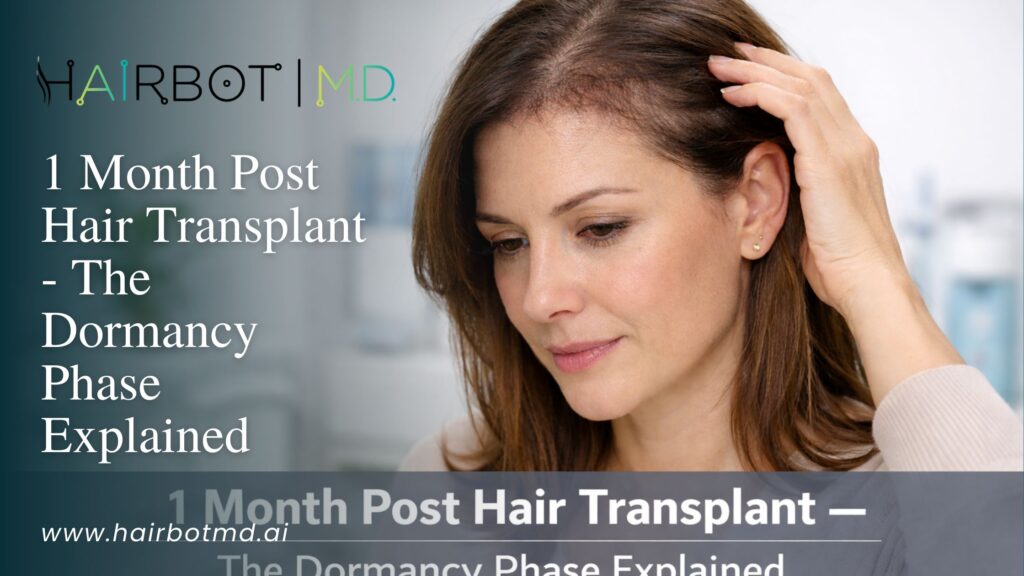
1 month post hair transplant is a clinical “quiet phase,” not a cosmetic results phase. At 1 month post hair transplant, most patients look healed on the surface, but the follicles are internally transitioning into telogen (resting) after surgical relocation.
That biology is the reason 1 month post hair transplant often feels confusing: crusts are gone, swelling is down, and the scalp may look close to normal, yet density can look reduced because post-operative shedding (often called shock loss or telogen effluvium) is common in this window.
1 month post hair transplant can also include dryness, tightness, mild sensitivity, and intermittent itching because the skin barrier is still normalizing.
For HairBot MD patients, 1 month post hair transplant is best understood through two systems operating at the same time: wound physiology and follicular cycling.
By day 30, the tissue has generally progressed through hemostasis → inflammation → epithelialization and is now entering early remodeling, while transplanted follicles temporarily “reset” their cycle before re-entering anagen (growth) later.
This means 1 month post hair transplant is not the right time to chase speed. The goal at 1 month post hair transplant is to protect the scalp microenvironment, prevent chronic inflammation, and preserve native hair stability so the grafts can re-emerge on schedule.
If you treat 1 month post hair transplant like a protocol, calm scalp, low friction, controlled heat, and disciplined monitoring, you protect long-term density and avoid unnecessary panic.
1 Month Post Hair Transplant – What’s Happening Under the Scalp (Healing + Follicle Cycling)
Clinical Milestones You Should Expect at Day 30
At 1 month post hair transplant, the most important concept is that surface healing and hair cycling are not on the same timeline. Surface closure can look “done,” while follicles are biologically quiet.
Understanding 1 month post hair transplant requires separating what you see (skin and hair shafts) from what matters (follicle bulbs and dermal recovery).
A) Tissue healing status (recipient + donor)
At 1 month post hair transplant, recipient micro-incisions should be sealed and stable. With FUE, donor sites usually show faint “stippling” that continues to fade as remodeling progresses. The scalp at 1 month post hair transplant can still feel different because the barrier is not fully normalized yet.
Common texture findings include dryness, mild flaking, a tight sensation, or mild sensitivity when washing. These are often barrier-related, not infection-related, especially when they are gradually improving.
Redness patterns at 1 month post hair transplant vary by skin type and inflammatory sensitivity. Some patients look nearly normal; others, especially those with lighter skin tones, can have persistent erythema that slowly decreases over the next several weeks.
What matters clinically at 1 month post hair transplant is trend direction: redness should be stable or improving, not spreading or intensifying.
B) Follicle physiology status (telogen reset is expected)
At 1 month post hair transplant, it is common for transplanted hairs to shed as follicles enter telogen. This is not graft failure. In most cases, the visible hair shaft falls out, but the follicle bulb remains seated in the dermis. The follicle then rests before transitioning back into anagen later. This is the core biology of the dormancy phase: 1 month post hair transplant can look “empty” even when grafts are intact.
Some patients notice tiny dark dots or “pepper spots” at 1 month post hair transplant. These can be short hair remnants, pigment at the follicle opening, or early cycling activity.
Small bumps can also occur as oil glands and follicles normalize. Mild, occasional follicle bumps can be normal; widespread, inflamed bumps that worsen need evaluation.
C) What density looks like at 1 month (why it can look worse)
At 1 month post hair transplant, density often appears worse than baseline for three reasons: shedding of transplanted shafts, temporary shedding of native hair (shock loss), and short hair length that exaggerates scalp show-through under bright light.
Hairline areas can look “cleaner” earlier because they are more visually structured, while crown zones often lag because crown hair has different growth angles, whorl dynamics, and often slower maturation.
D) Clinical red flags at 1 month
At 1 month post hair transplant, contact your clinic if you notice any of the following
- Spreading redness with warmth, escalating tenderness, or increasing pain
- Discharge, crusting that returns with odor, or fever/systemic symptoms
- Sudden bleeding or crater-like openings in the recipient area
- Persistent, severe folliculitis that worsens over days instead of improving
HairBot MD typically reviews these patterns during follow-ups to confirm that 1 month post hair transplant changes are on track, rather than inflammatory or infectious.
“Ready to embrace the future of hair restoration? Schedule your free precision consultation today.”
1 Month Post Hair Transplant – The Dormancy Phase Explained (What to Do Now)
The 5 Protective Behaviors That Preserve Long-Term Density
The mistake at 1 month post hair transplant is trying to “do more” because growth is not visible. The smarter approach at 1 month post hair transplant is to protect the environment so follicles can restart growth cleanly.
These five behaviors are designed to minimize perifollicular inflammation, reduce mechanical stress, and preserve both transplanted and native hair.
1) Inflammation control (scalp discipline)
At 1 month post hair transplant, inflammation control means avoiding irritant exposures. The scalp barrier may still be reactive, and harsh products can prolong redness and itching.
- Avoid harsh shampoos, strong fragrances, and aggressive anti-dandruff actives unless cleared
- Avoid acids, scrubs, aggressive exfoliation, and “DIY” scalp treatments
- Do not scratch; itching should be managed with physician-approved moisturizers/foam or guidance
A stable, low-irritation scalp at 1 month post hair transplant reduces the itch–touch–inflammation loop that delays calm healing.
2) Mechanical protection (reduce micro-trauma)
At 1 month post hair transplant, grafts are typically more secure than in the first 10 days, but repeated friction can still irritate the scalp and trigger inflammation.
Normal washing is usually allowed at 1 month post hair transplant, but technique still matters. Use fingertip pads rather than nails, avoid high-pressure shower streams, and avoid aggressive rubbing.
If hats are worn, choose loose, breathable options that do not create heat and friction. Helmets or very tight headwear can create heat build-up and repetitive micro-shear; if your lifestyle requires helmets, ask your clinic about safe timing and protective strategies.
3) Sweat + heat management (vasodilation and itch control)
At 1 month post hair transplant, sweating is not automatically dangerous, but unmanaged sweat can trigger itching and rubbing. Heat increases vasodilation and can prolong redness in sensitive patients.
Use a gradual return strategy at 1 month post hair transplant: start with lower-intensity exercise, shorter sessions, and immediate cleansing after sweating.
Avoid prolonged direct sun exposure, and use scalp protection to reduce UV irritation. The goal is to keep the 1-month post-hair-transplant scalp calm, not “revved up” daily by heat and friction.
4) Native hair preservation (density is grafts + native hair)
At 1 month post hair transplant, density depends on the combination of transplanted follicles and surrounding native hair. Native hair can still miniaturize over time, and native hair can also shed temporarily from surgical stress.
This is why HairBot MD often frames 1 month post hair transplant as a stabilization window: your job is to preserve the environment that supports both grafts and native follicles.
If medication therapy is appropriate, timing matters. Finasteride and minoxidil can be valuable for preserving native hair and supporting long-term density, but 1 month post hair transplant is not the time to self-start products on an irritated scalp.
Follow clinician-guided timing and dosing so you support growth without triggering dermatitis or shedding from irritation.
5) Monitoring and expectations (use metrics, not mirror panic)
At 1 month post hair transplant, daily mirror checks create emotional noise because biology is slow. Use a tracking system instead.
Here is a clean monitoring plan for 1 month post hair transplant and beyond
- Take standardized photos monthly (same lighting, distance, angles)
- Compare at 3 months, 6 months, and 12 months; those are clinically meaningful checkpoints
- Expect meaningful emergence to begin around months 3–4, then thickening and caliber maturation from months 6–12+
- Expect crown maturation to take longer than hairline maturation in many patients
The key is that 1 month post hair transplant is not a result check, it is a stability check. When you treat it that way, you protect the trajectory.
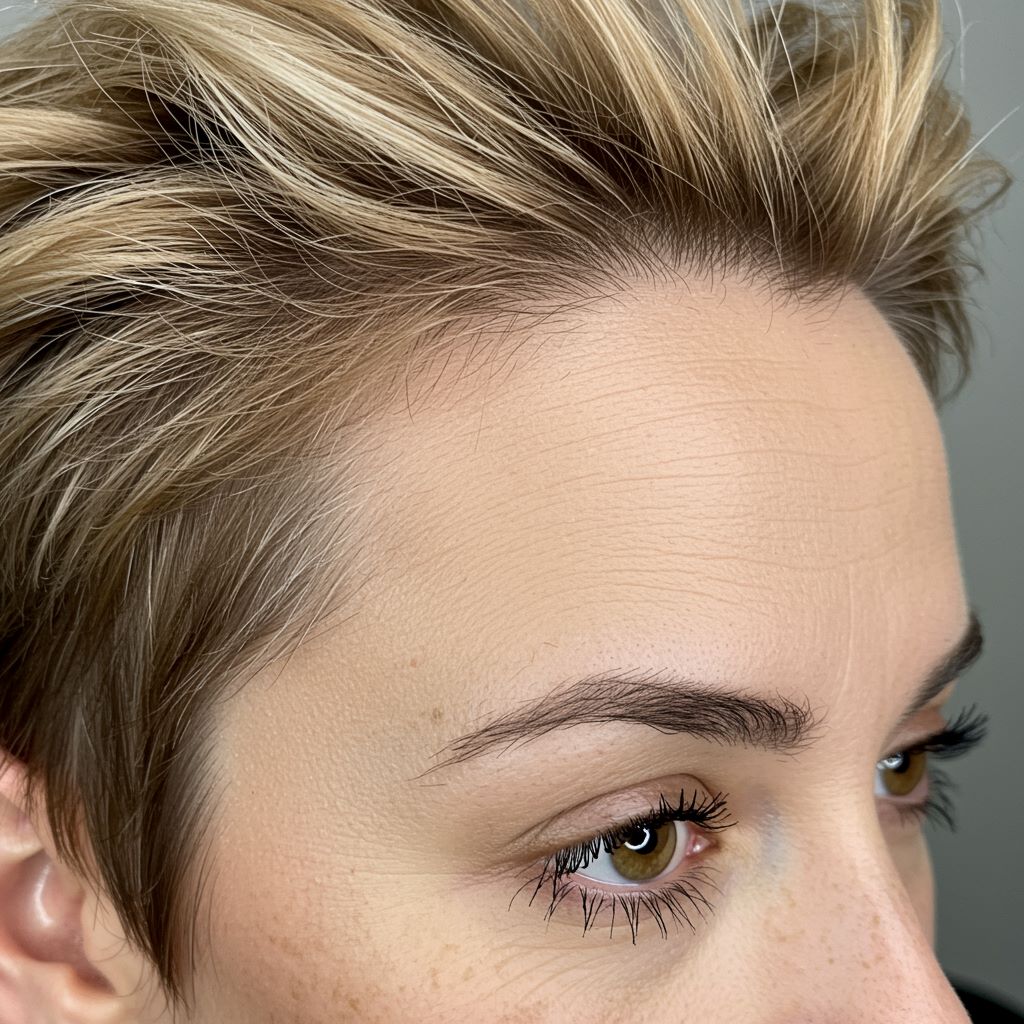
Final thoughts – 1 month post hair transplant
Post hair transplant outcomes are usually won or lost by behavior during predictable biological windows, and 1 month post hair transplant is the window where patients most commonly overjudge progress.
At 1 month post hair transplant, shedding and density fluctuation are common because follicles are resetting into telogen and preparing for anagen re-entry later.
That “quiet” surface can feel like nothing is happening, but internally, the follicular units are stabilizing in the dermis and waiting for the growth cycle to restart. When you understand that physiology, 1 month post hair transplant becomes easier to interpret and easier to manage.
The correct goal at 1 month post hair transplant is not acceleration, it is protection. Keep inflammation low, prevent friction and heat triggers, preserve native hair, and follow clinician-guided maintenance timing.
Track progress with monthly photos instead of daily mirrors and evaluate change at clinically relevant checkpoints like 3 months and 6 months. When managed like a protocol, 1 month post hair transplant becomes the stability platform that supports strong emergence in months 3–6 and cosmetic maturation through 12–18 months.
In HairBot MD terms, the win is predictable: a calm scalp now produces better density later, because biology rewards consistency, not urgency.
Redefine Hair Restoration – Advanced Robotic Transplant Solutions at HairBot MD
Step into the future of hair restoration with HairBot MD, your trusted destination for precision-driven robotic hair transplant technology. Our state-of-the-art platform combines cutting-edge robotics with expert medical oversight to deliver natural-looking results with unmatched accuracy and efficiency.
At HairBot MD, we specialize in robotic FUE transplants using systems like ARTAS®, offering minimally invasive procedures, faster recovery, and customized treatment planning. Whether you’re experiencing early-stage hair loss or seeking full restoration, our solutions are designed to meet your unique goals with confidence.
Explore our full range of services and discover how we blend science and artistry to deliver exceptional results. Visit our Home, learn more about our approach, or Contact us to speak with a specialist. Ready to take the first step? Get a Free Assessment today and start your journey to hair confidence.
📍 HairBot MD – Your Destination for Robotic Hair Transplant in Cypress, TX
Looking for the most advanced hair restoration solution near you? HairBot MD specializes in robotic hair transplants using the FDA-cleared ARTAS iX system, delivering precision, speed, and natural results.
✅ Address: 17110 House & Hahl Rd, B-2, Cypress, TX 77433
📞 Call Us: (346) 472-2353
✨ Claim Your Free HairBot MD Assessment!
Whether you’re curious about the ARTAS iX robotic system or ready to schedule a free consultation, our expert team is here to guide you through every step of your hair restoration journey.