
FUE hair transplant side effects should be treated like a post-op expectation map, not a fear list. When you understand FUE hair transplant side effects, you stop guessing and start tracking healing with the same logic a clinic uses.
The key is to separate expected inflammation and remodeling from true complications. Most FUE hair transplant side effects are predictable because FUE is controlled micro-injury: follicular unit extraction in the donor zone and recipient-site creation plus implantation in the restoration zone. That means your symptoms must be interpreted by zone and by time.
Technically, you have two surgical environments. The donor area is the safe donor zone where the punch removes follicular units and leaves tiny circular wounds that re-epithelialize. The recipient area is where sites are created and grafts are placed, triggering an inflammatory cascade and tissue remodeling. Both areas can look dramatic early, yet still be normal.
This guide breaks FUE hair transplant side effects into timeline phases so you can judge what is expected, what needs close monitoring, and what requires urgent escalation.
You’ll learn which FUE hair transplant side effects improve steadily with proper aftercare and which FUE hair transplant side effects signal infection, vascular compromise, donor overharvesting, or abnormal wound behavior.
Track symptoms clinically, not emotionally. Healing becomes easier when you know what “normal” actually looks like.
FUE Hair Transplant Side Effects That Are Normal During Healing (Timeline-Based)
FUE Hair Transplant Side Effects in the First 24–72 Hours (Erythema, Edema, Tightness)
In the first three days, FUE hair transplant side effects are dominated by acute inflammation, fluid shift, and tissue reactivity. The donor and recipient behave differently, but both can look worse before they look better.
Early FUE hair transplant side effects are typically self-limited if you protect grafts and reduce friction. Expected physiology in this window includes:
- Erythema: Procedure-related vasodilation and local immune signaling
- Edema: Fluid shift that can move downward to the forehead or upper face
- Tightness/pressure: Common in the recipient zone due to swelling and site creation
- Tenderness: Donor soreness that often feels like a “sunburn” or bruise
What HairBot MD would guide you to track for these FUE hair transplant side effects:
- Location: Donor vs recipient, or diffuse swelling across the scalp
- Symmetry: Even swelling is common; sudden one-sided swelling is not
- Temperature: Mild warmth can be normal; hot skin with worsening pain is not
- Pain trend: Discomfort should stabilize or improve, not escalate daily
- Progression: Swelling peaks then reduces; it should not keep expanding
Helpful guide behaviors to reduce early FUE hair transplant side effects:
- Keep head elevation during sleep to reduce edema
- Avoid bending and heavy lifting that increases scalp pressure
- Follow prescribed analgesia; avoid random medication mixing
- Do not touch, rub, or compress the recipient zone
The technical rule: early FUE hair transplant side effects should follow a curve, rise, peak, then decline. If the curve only rises, that’s when evaluation becomes important.
FUE Hair Transplant Side Effects in Days 3–10 (Crusting, Scabbing, Pruritus)
Days 3–10 are the “visible healing” phase. Many FUE hair transplant side effects in this window are the scalp doing mechanical repair: sealing micro-wounds, re-epithelializing extraction sites, and stabilizing graft units. This is also when patients create problems by picking, scrubbing, or “testing” graft security.
Expected findings for FUE hair transplant side effects include
- Micro-crusting at recipient sites as plasma and serum dry around graft openings
- Scabbing that looks worse under bright light but is often normal
- Pruritus (itching) as epithelial repair progresses and nerve endings wake up
- Mild serous ooze early if present, which should reduce quickly
What these FUE hair transplant side effects mean technically
- Crusting is not “dirt.” It is coagulated serum and healing debris.
- Itching is not always an allergy. It can be tissue repair and dryness.
- Some redness is inflammatory remodeling, especially in lighter skin.
- In darker skin, redness can be less visible, so heat and tenderness matter more.
Practical, technical aftercare notes to control FUE hair transplant side effects
- Use a gentle wash technique that reduces mechanical shear on grafts
- Let softened crusts release gradually rather than forcing removal
- Avoid aggressive exfoliation, scrubs, or strong actives in this phase
- No picking, risk includes graft dislodgement and secondary infection
A simple monitoring checklist for this phase
- Are crusts loosening with washing rather than thickening?
- Is itching improving with hydration and gentle care?
- Is redness stable or slowly fading?
- Is pain mild and decreasing rather than sharp and increasing?
Most FUE hair transplant side effects here are normal when they are improving and localized. The “not normal” pattern is worsening redness with heat, new drainage, or increasing pain.
FUE Hair Transplant Side Effects in Weeks 2–8 (Shedding + Shock Loss Explained Clinically)
Weeks 2–8 are the phase where patients panic, even though the biology is expected. Many FUE hair transplant side effects in this window are related to hair cycle transitions rather than graft death. Your follicles may be alive but “silent” while they reset.
You must separate the two shedding pathways in the FUE hair transplant side effects
- Transplanted hair shedding: Expected telogen reset of implanted follicles
- Shock loss: Telogen effluvium of vulnerable native hairs near the recipient zone
Clinical explanation of why these FUE hair transplant side effects happen
- Implantation triggers inflammation and microvascular adaptation.
- The hair shaft can shed while the follicle remains viable.
- Native hairs in miniaturized zones can be pushed into telogen by stress.
Risk modifiers that can increase shedding-type FUE hair transplant side effects
- High-density packing in fragile recipient tissue
- Excess recipient-site trauma or prolonged procedure time
- Pre-existing miniaturization and active androgenetic alopecia
- Scalp inflammation, seborrheic dermatitis, or poor tolerance to products
How to interpret these FUE hair transplant side effects without guessing
- Shedding that begins after early healing and then stabilizes is common.
- Sudden shedding with scalp burning, redness, and scaling suggests inflammation.
- Donor shedding can occur from trauma, but it should not look patchy and “eaten.”
Helpful guide actions
- Keep scalp care barrier-friendly; dryness worsens symptom perception
- Avoid switching products repeatedly during the shedding phase
- If you use medical therapy, consistency matters more than panic changes
The important truth: many FUE hair transplant side effects in weeks 2–8 are cycle-related events and not an outcome signal.
FUE Hair Transplant Side Effects in Months 1–4 (Folliculitis, Pimples, Texture Changes)
Months 1–4 are where healing shifts from closure to remodeling and early emergence. Some FUE hair transplant side effects look like acne or rash, but they can be sterile inflammatory responses as hairs begin to break through. The key is to separate sterile folliculitis from infectious folliculitis.
Explain sterile folliculitis vs infectious folliculitis in FUE hair transplant side effects
- Sterile folliculitis: Small papules/pustules caused by trapped hairs, keratin, or irritation
- Infectious folliculitis: Bacteria-driven inflammation with spreading redness, tenderness, and sometimes drainage
What are the usual FUE hair transplant side effects in this phase
- Mild bumps that come and go
- Intermittent sensitivity when washing
- Temporary texture changes in the donor zone
- Occasional “pimple-like” lesions near emerging hairs
What HairBot MD would advise (guide tone) for these FUE hair transplant side effects
- Don’t self-treat aggressively with harsh acids or scrubs early
- Don’t squeeze lesions; squeezing increases deeper inflammation
- Report persistent, painful, spreading bumps to your clinic
A practical differentiation checklist
- Normal-leaning: Localized bumps, mild discomfort, stable redness, improves over days
- Concerning: Expanding redness, heat, increasing pain, thick drainage, fever
Also expect that “growth doesn’t feel linear.” Early emergence can be uneven. Many FUE hair transplant side effects are simply the scalp adapting to new growth cycles.
FUE Hair Transplant Side Effects in Months 3–12 (Numbness, Tingling, Patchy Early Growth)
Months 3–12 is where patients judge results, but the tissue is still maturing. Some FUE hair transplant side effects are neurosensory and can persist longer than people expect. Others are visual, patchy early growth that reflects asynchronous cycling.
Normal neuro-sensory recovery in FUE hair transplant side effects can include
- Hypesthesia: Reduced sensation in donor or recipient areas
- Paresthesia: Tingling, pins-and-needles, “electric” sensitivity
- Intermittent tenderness around the extraction zones
Why do these FUE hair transplant side effects happen
- Cutaneous nerve endings are disrupted during punching and site creation.
- Nerves regenerate slowly; sensation often returns gradually and unevenly.
Growth reality you must know
- Early “patchiness” often reflects asynchronous cycling, not failure.
- Hairline and mid-scalp often show earlier visible change than the crown.
- Caliber improvement can lag behind the first visible sprouts.
Monitoring checkpoints for these FUE hair transplant side effects:
- Standardized photo baselines in consistent lighting
- Hair shaft caliber changes in previously miniaturized zones
- Density trend across months, not weeks
- Scalp inflammation status: redness, flaking, burning, persistent itch
Guide habits that reduce interpretive mistakes:
- Do not assess density day-to-day. Track monthly.
- Do not compare early growth across different scalp zones.
- Do not ignore ongoing progression in native hair outside the transplanted region.
Most long-phase FUE hair transplant side effects are normal when they are improving or stable. The red-flag pattern is persistent deterioration or signs of tissue compromise.
Unsure how many grafts you actually need? Get a personalized graft-count assessment at HairBot MD based on your pattern, donor limits, and future hair-loss risk.
FUE Hair Transplant Side Effects That Are NOT Normal (Red Flags + When to Escalate)
FUE Hair Transplant Side Effects That Suggest Infection (Cellulitis Signs + Systemic Symptoms)
Infection is not the most common outcome, but it is the outcome you must not delay. Infection-type FUE hair transplant side effects progress, spread, and feel hotter and more painful than normal healing.
Red flags for infection-related FUE hair transplant side effects
- Expanding redness that spreads beyond the original treated area
- Increased warmth and worsening tenderness day-by-day
- Purulent drainage (thick, yellow/green discharge)
- Fever, chills, malaise, or systemic fatigue
- New swelling after the early swelling window should have improved
What to do
- Seek a same-day clinical evaluation. Do not “wait it out.”
- Don’t mask symptoms with random antibiotics or leftover medication.
- Avoid topical irritants that blur the clinical picture.
Normal FUE hair transplant side effects improve over time. Infectious patterns intensify over time.
FUE Hair Transplant Side Effects That Signal Vascular Compromise (Severe Pain, Darkening Skin, Necrosis Risk)
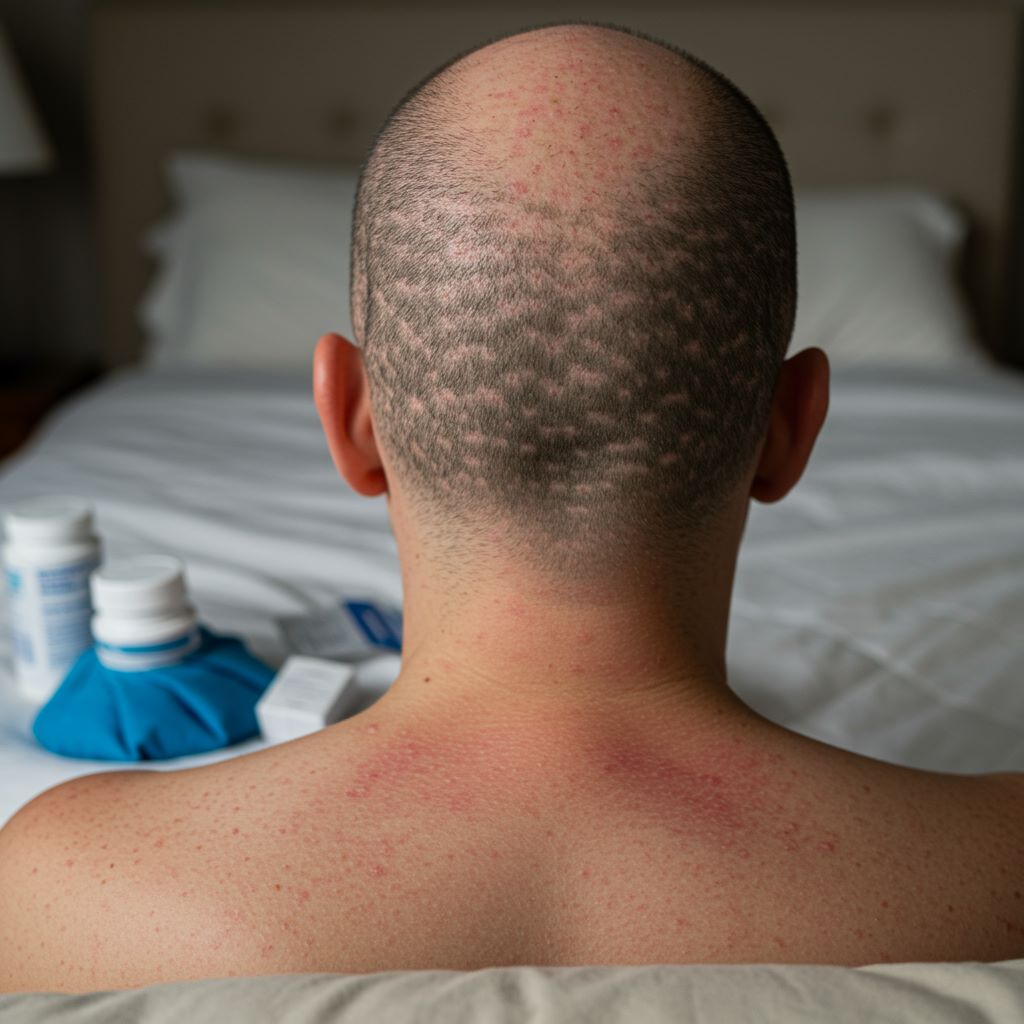
Vascular compromise is rare, but it is urgent. These FUE hair transplant side effects are about tissue survival, not comfort. If the blood supply is impaired, skin can darken and fail to heal.
Rare but urgent markers in FUE hair transplant side effects
- Disproportionate pain that feels severe and out of pattern
- Dusky, gray, purple, or black discoloration
- Non-healing areas that look “dry,” sunken, or progressively worse
- Rapid change in tissue appearance rather than slow improvement
Mechanism (brief and technical)
- Excess tissue trauma or thermal load
- Compromised microcirculation in dense recipient work
- Uncontrolled inflammation causes poor perfusion
Action rule
- Treat this as an emergency escalation to the clinic.
- Do not attempt home remedies or aggressive cleaning.
This is one category where FUE hair transplant side effects are not “watch and wait.” They are “evaluate now.”
FUE Hair Transplant Side Effects from Donor Mismanagement (Overharvesting + Permanent Thinning)
Overharvesting is a planning error, not a healing phase. Donor-related FUE hair transplant side effects should not evolve into a visible “moth-eaten” pattern. In technical terms, safe donor extraction requires controlled spacing, controlled punch size, and respect for the long-term donor reserve.
Clinical explanation
- Exceeding safe extraction density can create visible donor thinning
- Poor distribution produces patchiness rather than uniform softening
- Larger punches and tight spacing increase cosmetic visibility
What to assess if donor FUE hair transplant side effects look abnormal
- Donor uniformity under direct light and short hair length
- Evidence of patchy zones rather than evenly distributed extraction
- Persistent see-through areas that do not improve after maturation
- Scarring visibility and skin texture change beyond the expected
Donor healing does take time, but donor planning errors look structural, not temporary. If the donor pattern looks irregular and worsens, that is not a normal FUE hair transplant side effect.
FUE Hair Transplant Side Effects That Mean Poor Wound Behavior (Persistent Swelling, Hematoma, Delayed Healing)
Poor wound behavior refers to healing that stalls or moves backward. These FUE hair transplant side effects are not “normal swelling.” They are persistent inflammation, fluid collection, or delayed closure.
Abnormal patterns
- Swelling worsening after day 3–4 instead of improving
- Expanding firmness or pressure that suggests a fluid or hematoma
- Persistent drainage or wetness beyond the early closure stage
- Severe tenderness that escalates rather than declines
Risk drivers that worsen these FUE hair transplant side effects
- Blood-thinner exposure or unapproved NSAID use early
- Smoking or nicotine exposure impairs microvascular repair
- Non-compliance: Friction, early sweating, helmet pressure, scratching
- Treating irritated skin or existing dermatitis during recovery
Action rule
- If you see worsening firmness, new swelling, or persistent drainage, contact your clinic.
- Delayed healing is not the time for experimentation.
FUE Hair Transplant Side Effects That Point to Growth Failure (Beyond Normal Timeline)
It’s normal for growth to be slow and uneven early. But some FUE hair transplant side effects become concerning when the growth trend is absent beyond realistic time windows, or when the scalp remains chronically inflamed.
When concern becomes valid
- No meaningful growth trend when the expected window has passed
- Persistent inflammation: burning, scaling, chronic redness
- Ongoing shedding that never stabilizes
- Progressive thinning in non-transplanted areas signaling ongoing androgenetic loss
Differential checklist (technical) for these FUE hair transplant side effects
- Ongoing androgenetic progression without stabilization therapy
- Scalp inflammation (seborrheic dermatitis, folliculitis, irritant dermatitis)
- Nutritional or endocrine drivers (iron deficiency, thyroid issues)
- Traction or mechanical trauma during recovery
- Poor graft handling or excessive recipient trauma
- Overly aggressive density attempts in fragile tissue
Guide approach
- Use standardized photos and clinical checkpoints.
- Focus on trend and tissue health, not daily mirror checks.
- If you suspect abnormal healing, escalate early instead of waiting months.
Growth interpretation is a discipline. Many FUE hair transplant side effects are not failures; they are signals that the timeline is still running. But chronic deterioration is not normal.
Conclusion – FUE Hair Transplant Side Effects Decision Rule
FUE hair transplant side effects become manageable when you apply one decision rule: FUE hair transplant side effects are “normal” when they follow the expected healing timeline and steadily improve, and FUE hair transplant side effects are “not normal” when they escalate, spread, or produce systemic symptoms.
You should expect FUE hair transplant side effects like early erythema, edema, crusting, itching, and shedding because they reflect predictable inflammation and hair-cycle reset. You should also expect some FUE hair transplant side effects to look dramatic while still being clinically normal, especially during days 3–10 and weeks 2–8. The scalp is remodeling, and that remodeling is visible.
But you must treat certain FUE hair transplant side effects as red flags: expanding heat and redness, purulent drainage, fever, disproportionate pain, darkening skin, non-healing areas, worsening swelling after the early window, and donor patterns that look patchy or over-extracted.
Those patterns suggest infection, vascular compromise, abnormal wound behavior, or donor mismanagement. They require clinic-level review, not home troubleshooting.
Track FUE hair transplant side effects like a clinician: zone-specific, time-stamped, and trend-based. If the curve improves, you stay calm and consistent.
If the curve worsens, you escalate fast. That is the safest way to protect grafts, protect the donor reserve, and keep recovery predictable at HairBot MD.
Redefine Hair Restoration – Advanced Robotic Transplant Solutions at HairBot MD
Step into the future of hair restoration with HairBot MD, your trusted destination for precision-driven robotic hair transplant technology. Our state-of-the-art platform combines cutting-edge robotics with expert medical oversight to deliver natural-looking results with unmatched accuracy and efficiency.
At HairBot MD, we specialize in robotic FUE transplants using systems like ARTAS®, offering minimally invasive procedures, faster recovery, and customized treatment planning. Whether you’re experiencing early-stage hair loss or seeking full restoration, our solutions are designed to meet your unique goals with confidence.
Explore our full range of services and discover how we blend science and artistry to deliver exceptional results. Visit our Home, learn more about our approach, or Contact us to speak with a specialist. Ready to take the first step? Get a Free Assessment today and start your journey to hair confidence.
📍 HairBot MD – Your Destination for Robotic Hair Transplant in Cypress, TX
Looking for the most advanced hair restoration solution near you? HairBot MD specializes in robotic hair transplants using the FDA-cleared ARTAS iX system, delivering precision, speed, and natural results.
✅ Address: 17110 House & Hahl Rd, B-2, Cypress, TX 77433
📞 Call Us: (346) 472-2353
✨ Claim Your Free HairBot MD Assessment!
Whether you’re curious about the ARTAS iX robotic system or ready to schedule a free consultation, our expert team is here to guide you through every step of your hair restoration journey.