
At the stage of hair transplant after 6 months, most patients are no longer in the “healing” phase. They are in the maturation initiation window, the point where the new hairs have started to show, but the result is still building. This is why the 6-month mark often feels confusing: you can finally see change, yet it may still look uneven, lighter than expected, or not fully blended.
To understand hair transplant after 6 months, it helps to separate emotions from biology. The follicles are working, but many hair shafts are still early in development. In many cases, around 50–60% of the final visible result is present by this time.
That number is a general guide, not a guarantee, because progress depends on factors like donor hair thickness, blood supply in the recipient area, graft survival, and whether the work was done in the hairline or crown.
A well-performed hair transplant after 6 months usually shows clear signs of progress: new hair emerging, gradual thickening, and a scalp that looks calm and fully healed (no scabs). This guide explains what “50–60% growth” actually means, why patchiness can still be normal, and how to evaluate your progress in a practical, medically informed way.
Hair Transplant After 6 Months – Understanding the 50–60% Growth Benchmark
After 6 months of hair transplant, most grafts have already passed the key “survival steps” that happen earlier in recovery. By this stage, the follicles have typically completed
- Revascularization (the follicles reconnect with the blood supply)
- Dermal anchoring (the grafts are stable in the skin)
- Early anagen reactivation (the follicles restart active growth)
So what does the 50–60% number really mean in a hair transplant after 6 months timeline?
It usually refers to visible hair emergence, not final density. That’s a big difference. You may have many follicles that are alive and functioning, but the hairs they produce are still:
- Thinner than your natural “terminal” hair
- Lighter in color at first
- Shorter and less cooperative for styling
- Not yet fully synchronized in their growth cycles
What 50–60% Means Clinically
In a typical hair transplant, after 6 months, many patients notice
- The hairline shape is now visible and starting to look “real.”
- The mid-scalp may look improved, but still not filled
- The crown often looks behind (this is common)
- Some hairs look soft or fine, while others look stronger (mixed caliber)
One simple but important rule: density is not only about graft count. Density is also about hair shaft thickness. If the hairs are still fine, the scalp can show through even when the follicles are growing correctly.
That’s why a hair transplant after 6 months can look “patchy” and still be normal. Over the next few months, the result improves through
- Hair shaft diameter expansion (hairs become thicker)
- Pigment and texture normalization (hair looks more like your original hair)
- Better cycle alignment (more hairs grow together instead of randomly)
So if you are seeing growth but it doesn’t feel “dense” yet, it often means you are in the middle of the normal maturation process.
Hairline vs Crown Progression Patterns
A key reason people worry about hair transplant after 6 months is that growth is not evenly distributed. Hairline and crown behave differently.
Hairline region (usually faster)
- Better blood supply
- Straight-line framing makes progress more visible
- Earlier improvement in appearance
- Easier to judge shape and direction
Crown region (often slower)
- Whorl pattern spreads hairs in different directions
- Needs more density to look full
- Can take longer to “read” visually in photos
- Maturation can extend to 12–18 months
So a crown that looks underwhelming after a hair transplant after 6 months does not automatically mean failure. It often means the crown is still in the slow-build stage.
What matters more at a hair transplant after 6 months is whether the pattern is moving forward. A helpful checkpoint list is
- Are new hairs clearly present?
- Is the hairline direction looking natural?
- Is the scalp calm (no scabs, no open areas)?
- Is donor healing stable without visible thinning patches?
- Are you seeing gradual month-to-month improvement?
If the answer is “yes” to most of these, you are usually on track.
“Unsure if PRP is worth it for your hair goals? Get the evidence and insights now!”
Hair Transplant After 6 Months – What Is Normal, What Requires Review
A medically stable hair transplant after 6 months should look and feel like a healed scalp with ongoing growth. By now, the “surgery look” should mostly be gone. In most cases, you should see
- No scabbing or crusting
- No strong redness that keeps spreading
- No active pain in the recipient zone
- A donor area that looks blended and stable
- Hair growth that is present, even if not complete
It’s also important to know that shedding at hair transplant after 6 months is often not the transplanted hair. If shedding appears at this stage, it is more commonly related to native hair that is sensitive to hormones or stress, especially in androgenetic alopecia.
Supportive therapies at this stage
Some patients consider supportive treatments during hair transplant after 6 months. These do not “force” instant results, but they can help protect and strengthen hair, especially native hair around the transplant.
Common supportive options include
- Finasteride (helps reduce DHT impact on native hair in suitable patients)
- Topical minoxidil (supports growth cycling and scalp support in many users)
- PRP therapy (uses platelet-derived growth factors as an adjunct)
- Low-level laser therapy (LLLT) (non-invasive scalp stimulation support)
A practical way to think about these: they are usually best for holding and strengthening existing hair and supporting the overall environment, not “reviving” dead grafts.
If grafts did not survive, supportive therapy cannot recreate them. But if grafts are alive and maturing slowly, supportive care may help the journey feel more stable.
Indicators of Healthy Maturation vs Red Flags
Here are signs that the hair transplant after 6 months is progressing in a healthy way
Healthy signs
- Hair is gradually thickening month by month
- Styling control is improving (even slightly)
- Texture starts to feel less wiry over time
- Scalp feels calm (no burning, no spreading redness)
- Small, uneven areas slowly begin filling in
And here are situations where a clinic review is reasonable
When to request a clinical evaluation
- No visible emergence at all by 6 months
- Persistent bumps, pus, or painful swelling (possible folliculitis/infection)
- Scars that look widened or worsening instead of settling
- The donor area looks patchy or over-thinned
- Ongoing bleeding, crusting, or open areas (not expected)
A key truth, low density at hair transplant after 6 months does not automatically mean graft failure. Many people simply mature more slowly, especially in the crown. A more reliable “final judgment” window often starts around 9–12 months, when thickness and coverage become clearer.
If you’re worried, avoid comparing your progress to someone else’s photos. Different graft counts, hair thickness, and styling choices can make results look dramatically different at the hair transplant after 6 months, even when both are normal.
“Just had a hair transplant? Discover exactly how your recovery progresses by Day 7!”
Final Thoughts – Hair Transplant After 6 Months
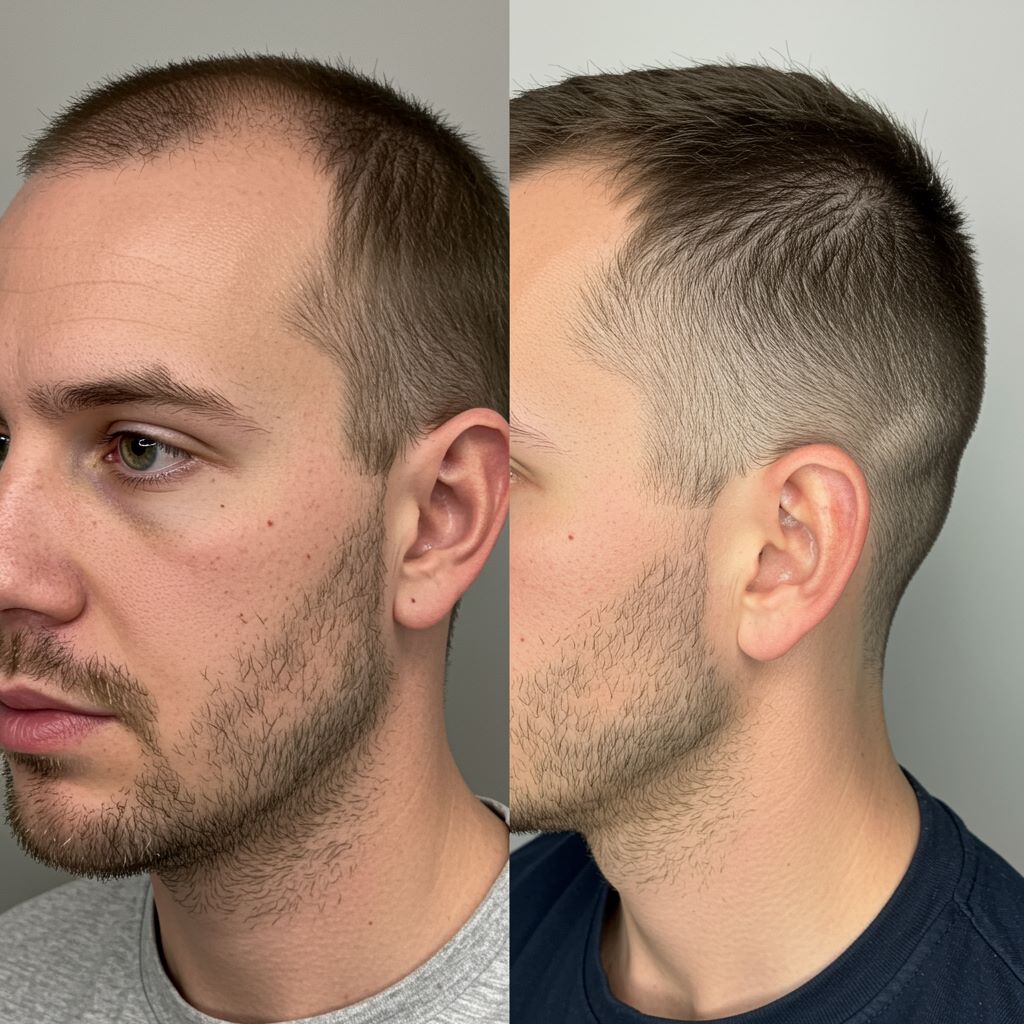
A properly executed hair transplant after 6 months is best understood as progress, not the finish line. This milestone often shows the first “real” cosmetic change, but it is still a developing stage where density is building and hair shafts are thickening.
The common idea of 50–60% growth in hair transplant after 6 months refers mainly to what you can see today, not what you will have at the end. Your final look depends heavily on how much the hairs thicken and matures between months 6 and 12.
Patchiness at hair transplant after 6 months is often normal, especially if the crown was treated. The crown can take longer because its swirl pattern needs more density to look full.
What matters most at this stage is clear signs of forward movement: visible new hairs, gradual thickening, a calm scalp, and stable donor healing.
At HairBot MD, the goal of hair transplant after 6 months is not to “judge success” with one photo. It’s to evaluate direction: growth pattern, thickness trend, donor preservation, and the plan for continued maturation. Remember the guiding rule:
Six months show the trajectory.
Twelve months define the result.
Redefine Hair Restoration – Advanced Robotic Transplant Solutions at HairBot MD
Step into the future of hair restoration with HairBot MD, your trusted destination for precision-driven robotic hair transplant technology. Our state-of-the-art platform combines cutting-edge robotics with expert medical oversight to deliver natural-looking results with unmatched accuracy and efficiency.
At HairBot MD, we specialize in robotic FUE transplants using systems like ARTAS®, offering minimally invasive procedures, faster recovery, and customized treatment planning. Whether you’re experiencing early-stage hair loss or seeking full restoration, our solutions are designed to meet your unique goals with confidence.
Explore our full range of services and discover how we blend science and artistry to deliver exceptional results. Visit our Home, learn more about our approach, or Contact us to speak with a specialist. Ready to take the first step? Get a Free Assessment today and start your journey to hair confidence.
📍 HairBot MD – Your Destination for Robotic Hair Transplant in Cypress, TX
Looking for the most advanced hair restoration solution near you? HairBot MD specializes in robotic hair transplants using the FDA-cleared ARTAS iX system, delivering precision, speed, and natural results.
✅ Address: 17110 House & Hahl Rd, B-2, Cypress, TX 77433
📞 Call Us: (346) 472-2353
✨ Claim Your Free HairBot MD Assessment!
Whether you’re curious about the ARTAS iX robotic system or ready to schedule a free consultation, our expert team is here to guide you through every step of your hair restoration journey.