
Hair transplant recovery is a biological and surgical healing process, not just cosmetic downtime. The moment graft placement ends, your scalp enters a controlled wound-healing sequence: hemostasis, inflammation, epithelial closure, and early remodeling.
That sequence is predictable, but it can look “messy” on the surface, redness, swelling, crusts, itching, and shedding can all appear before anything looks better. The mistake most patients make is treating every visible change as a sign the transplant is failing, when most signs are actually normal milestones inside hair transplant recovery.
At the same time, a smaller subset of symptoms signals true complications. Infection, hematoma, allergic medication reactions, or abnormal inflammation patterns can threaten graft survival if they’re ignored. That’s why HairBot MD frames hair transplant recovery as signal interpretation.
We don’t do reassurance-based guessing. We triage signs based on timing, progression, distribution, and severity, because healing has “rules.” Normal symptoms typically peak and then calm. Warning signs usually escalate, spread, or become disproportionate to the stage of recovery.
This guide is built to help you separate normal hair transplant recovery from red flags that require medical attention. It uses clinical thresholds, expected tissue behavior, and timeline logic, not anecdotes.
If you understand what should happen, when it should happen, and what should never happen, you protect your grafts, reduce anxiety, and make the next phases, shedding, dormancy, and regrowth, far more predictable.
Hair Transplant Recovery – Normal Healing Signs You Should Expect
Healthy hair transplant recovery follows a pattern. Your scalp is healing thousands of micro-incisions in the recipient zone and hundreds to thousands of extraction sites in the donor zone (especially after FUE).
The body responds with inflammation, fluid shifts, crusting, and sensory changes. Those responses are not complications by default. They’re expected physiology, unless they break timeline rules or intensity thresholds.
Inflammatory Responses (Days 0–7)
Acute inflammation is not “bad.” It’s how the body seals, protects, and rebuilds tissue. In the first week of hair transplant recovery, capillaries become more permeable, fluid moves into tissues (edema), and immune cells clean microscopic injury sites. This is how graft beds stabilize and how donor sites close.
A typical swelling pattern during hair transplant recovery looks like this: swelling begins in the scalp, then migrates forward into the forehead and sometimes around the eyes (periorbital area). That migration can feel alarming, but it’s often just gravity and fluid dynamics. The peak commonly occurs around days 2–3, then begins to resolve.
Erythema (redness) is also expected. The intensity depends on skin tone, vascular reactivity, and how aggressively the scalp responds to trauma.
Some patients clear redness quickly; others, especially fairer or more reactive skin can carry mild pinkness longer. The key is direction: normal redness gradually reduces and stays localized to treated zones.
Normal findings in early hair transplant recovery often include
- Mild to moderate scalp tightness, especially in the donor region
- Localized redness in recipient and donor zones
- Swelling peaking around day 2–3, then tapering
- Low-grade tenderness that improves day by day
- A “sunburn-like” sensation without escalating pain
What makes these signs normal is not that they exist. What makes them normal is that they follow a predictable curve: peak early, then fade. If your discomfort is getting worse after the initial days instead of better, that’s when you shift from “normal healing” to “evaluate for complications.”
Scabbing, Itching, and Sensory Changes
Scabbing is part of epithelial sealing. Each graft site can form a micro-crust as serum and small amounts of blood dry and seal the surface. In hair transplant recovery, these crusts protect the entry points while the skin closes underneath. The goal is not “no scabs.” The goal is scabs that form and then release naturally once the epidermis has sealed.
Itching is also common and often peaks when inflammation is settling and skin regeneration is active. Nerve endings are reactivating, the scalp is dry, and the healing surface can feel tight. Many patients interpret itching as infection. Most of the time, it’s nerve regeneration and dryness.
Temporary sensory changes are another normal part of hair transplant recovery. You may notice numbness, hypersensitivity, or a strange “dull pressure” sensation, especially in the donor area. This usually reflects local nerve irritation from extraction and swelling. It typically improves as tissues settle.
Here’s the HairBot MD reassurance logic that stops unnecessary panic
- Scabs ≠ graft failure (they are often a sign of proper sealing)
- Itching ≠ infection (often nerve regeneration + dryness)
- Numbness or hypersensitivity ≠ nerve damage (usually temporary irritation)
The rule is again pattern-based: normal hair transplant recovery symptoms fluctuate but trend toward improvement. If scabs persist abnormally long, worsen with increased redness, or develop discharge, then you reassess.
If itching becomes severe with heat, swelling, and spreading redness, you reassess. Normal healing is stable or improving. Complications tend to escalate.
Hair Transplant Recovery and Shedding
Shedding during hair transplant recovery is expected and does not equal graft death. The most common mechanism is postoperative telogen effluvium, where transplanted hair shafts shed because the follicles have been moved and temporarily “reset” in the growth cycle.
The follicle remains alive under the skin. The visible shaft falls, and the follicle transitions into a resting phase before it restarts production.
A critical distinction in hair transplant recovery is hair shaft loss vs follicular survival. The shaft is disposable. The follicle is the investment. Many patients see shedding between weeks 2–8 and assume the transplant “didn’t take.” In reality, that shedding is often the beginning of cycling.
Key patient education point
Shedding during hair transplant recovery is commonly evidence of follicle cycling, not graft loss.
There are exceptions, trauma, infection, or severe inflammation can damage grafts, but routine shedding alone is not one of them. That’s why you don’t diagnose failure based on shedding.
You diagnose recovery quality based on early healing behavior, scalp condition, and whether warning signs appeared.
Experiencing shock loss after an FUE hair transplant? Let HairBot MD assess your shedding pattern, protect graft health, and guide you through the recovery phase with medical clarity.
Hair Transplant Recovery – Warning Signs That Require Medical Attention
The purpose here is not to scare you. It’s to sharpen your pattern recognition. Warning signs in hair transplant recovery usually share one theme, they violate the timeline. Instead of improving, they worsen. Instead of remaining localized, they spread. Instead of being mild, they become disproportionate.
Red Flags in the Recipient Area
Recipient sites are delicate early on. Normal redness and mild tenderness should calm as the week progresses. If the opposite happens, that’s a signal.
Recipient-area warning signs during hair transplant recovery include
- Increasing pain after day 4–5 (especially if it becomes sharp or throbbing)
- Progressive redness spreading beyond the implant zone
- Purulent discharge (pus) or a foul smell
- Localized heat, swelling that intensifies, or pulsatile pain
Normal post-op inflammation feels like soreness and tightness that improves daily. Infection or pathological inflammation often feels like increasing pain, heat, and expanding redness. The scalp may feel “hot,” and the discomfort may no longer match the expected stage of recovery.
If you see discharge, smell, or worsening pain after the early window, treat it as a medical issue. In hair transplant recovery, delaying intervention can turn a minor problem into graft compromise.
Complications in the Donor Area
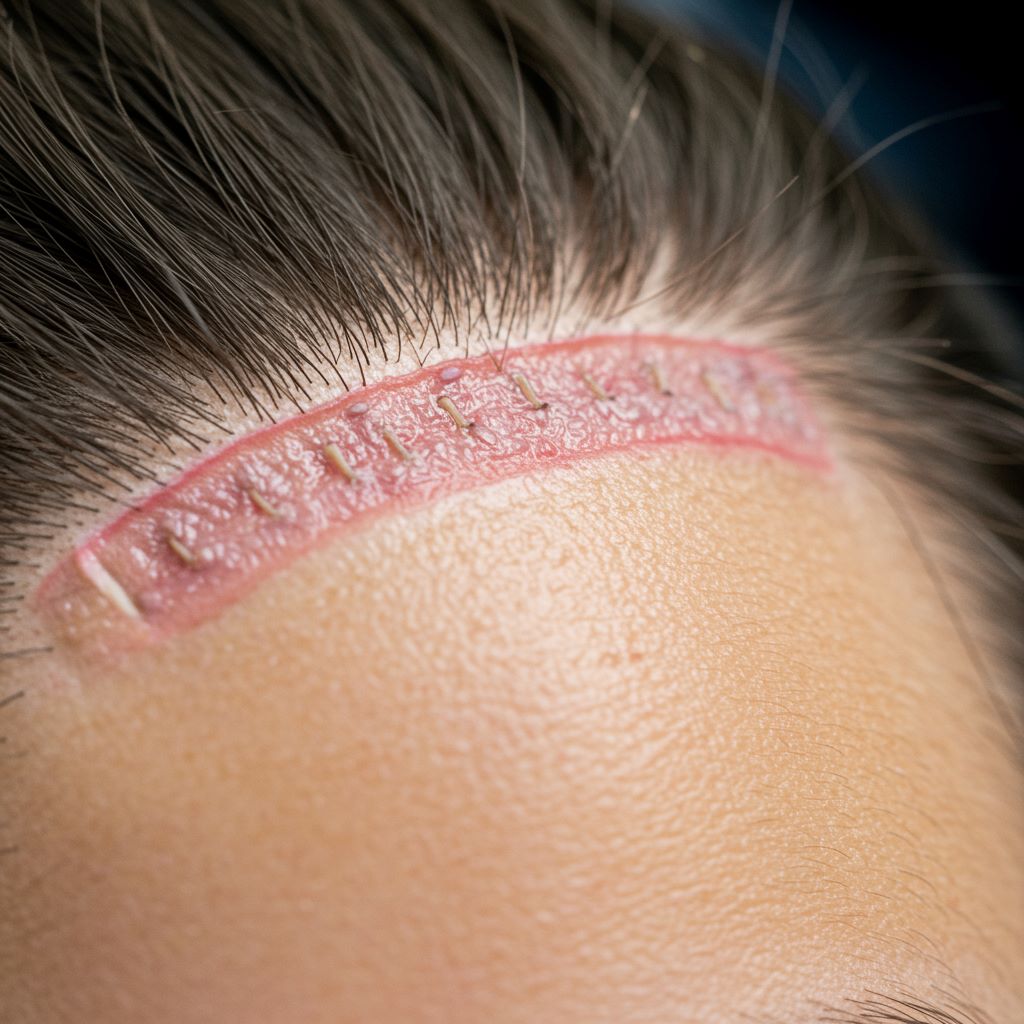
The donor zone can look rough early. After FUE, it is a field of micro-wounds that should close quickly. Mild tenderness and redness are expected. What isn’t expected is delayed closure, progressive firmness, or expanding pain.
Donor-area warning patterns in hair transplant recovery include
- Delayed epithelial closure (sites remain open or weepy longer than expected)
- Expanding tenderness or firm swelling (suggesting hematoma, infection, or significant inflammation)
- Folliculitis that becomes widespread, painful, or purulent
- Patchy donor thinning that looks excessive relative to the extraction plan
Folliculitis can be mild and self-limited, especially as hair begins to re-emerge. But painful pustules, spreading redness, fever, or significant swelling move it into “call your clinic” territory.
Also, donor shock loss can occur, but it’s typically temporary. Overharvesting indicators are different, they present as visibly depleted density patterns that do not match normal healing. That’s a surgical planning issue rather than a routine recovery symptom, and it should be evaluated clinically, not debated online.
Systemic Warning Signs
Systemic signals matter because they suggest your body is reacting beyond localized healing. Mild fatigue is normal after a procedure day. But fever, chills, or severe facial swelling is not something to “wait out.”
Non-negotiable escalation triggers in hair transplant recovery include
- Fever beyond 48–72 hours
- Chills, malaise, or worsening systemic weakness
- Severe facial swelling affecting vision
- Allergic medication reactions (rash, wheezing, lip/tongue swelling, rapid worsening symptoms)
If your swelling compromises the eyes or your symptoms suggest allergy, treat it urgently. Hair transplant recovery should not produce escalating systemic illness. When it does, you stop guessing and involve medical supervision immediately.
Thinking about a second hair transplant after 6 months? Get a physician-led evaluation at HairBot MD and plan your next step with clarity, donor safety, and long-term results in mind.
Conclusion – Hair Transplant Recovery Requires Interpretation, Not Guesswork
Hair transplant recovery becomes predictable when you understand what the scalp is doing and why. Most anxiety comes from mislabeling normal healing as complications, swelling gets mistaken for failure, scabs get mistaken for graft loss, itching gets mistaken for infection, and shedding gets mistaken for “it didn’t work.”
In reality, a large portion of hair transplant recovery is simply normal wound healing plus follicle cycling, and it often looks worse before it looks better. That’s not a flaw in the procedure. That’s biology doing its job.
HairBot MD’s approach is simple but strict: track timing, progression, and intensity not isolated symptoms. Normal signs usually peak early and then calm. They remain localized and gradually improve. Warning signs violate that curve.
They escalate instead of settling, spread instead of localizing, and become disproportionate to the day-by-day stage of healing. When patients follow that logic, they protect graft survival and reduce unnecessary panic during the early weeks.
Early identification of true red flags matters because the first weeks are when complications are most treatable and when long-term density is most protectable. Successful hair transplant recovery depends on education, discipline, and timely medical response not patience alone.
If you learn the difference between normal healing signals and warning signs, you’re no longer guessing. You’re managing recovery like it should be managed, clinically, calmly, and with outcomes in mind.
Redefine Hair Restoration – Advanced Robotic Transplant Solutions at HairBot MD
Step into the future of hair restoration with HairBot MD, your trusted destination for precision-driven robotic hair transplant technology. Our state-of-the-art platform combines cutting-edge robotics with expert medical oversight to deliver natural-looking results with unmatched accuracy and efficiency.
At HairBot MD, we specialize in robotic FUE transplants using systems like ARTAS®, offering minimally invasive procedures, faster recovery, and customized treatment planning. Whether you’re experiencing early-stage hair loss or seeking full restoration, our solutions are designed to meet your unique goals with confidence.
Explore our full range of services and discover how we blend science and artistry to deliver exceptional results. Visit our Home, learn more about our approach, or Contact us to speak with a specialist. Ready to take the first step? Get a Free Assessment today and start your journey to hair confidence.
📍 HairBot MD – Your Destination for Robotic Hair Transplant in Cypress, TX
Looking for the most advanced hair restoration solution near you? HairBot MD specializes in robotic hair transplants using the FDA-cleared ARTAS iX system, delivering precision, speed, and natural results.
✅ Address: 17110 House & Hahl Rd, B-2, Cypress, TX 77433
📞 Call Us: (346) 472-2353
✨ Claim Your Free HairBot MD Assessment!
Whether you’re curious about the ARTAS iX robotic system or ready to schedule a free consultation, our expert team is here to guide you through every step of your hair restoration journey.