
Hair transplant recovery day by day surprises many patients because the scalp can look healed long before the transplanted follicles actually recover underneath the skin. One of the biggest mistakes people make after FUE surgery is assuming redness fading away means the biologic healing process is finished.
In reality, hair restoration recovery moves through several overlapping clinical phases involving inflammation control, epithelial repair, vascular regeneration, follicular dormancy, and delayed growth activation.
After follicular unit extraction (FUE), the scalp immediately enters a complex wound-healing response. Tiny recipient-site incisions begin closing through epithelialization while donor areas start tissue remodeling and collagen repair.
At the same time, transplanted grafts rely on early revascularization to reconnect with the surrounding blood supply and stabilize inside the scalp environment.
During hair transplant recovery, day by day, follicles temporarily shift into the telogen phase before later re-entering active anagen growth cycles. This delayed transition is why shedding often appears before visible regrowth begins.
At HairBot MD, the ARTAS iX robotic system supports controlled graft harvesting precision, donor preservation, and consistent extraction geometry without relying entirely on manual variability.
This guide breaks down hair transplant recovery day by day from immediate healing through long-term density maturation, helping patients understand what is medically normal at every stage.
Hair Transplant Recovery Day by Day During the First 14 Days
The first two weeks after FUE surgery feel confusing for many patients because hair transplant recovery day by day changes very fast on the surface, while deeper biological healing still continues underneath the scalp.
Some redness, swelling, and crusting look alarming at first, but most of these changes are part of normal follicular recovery physiology.
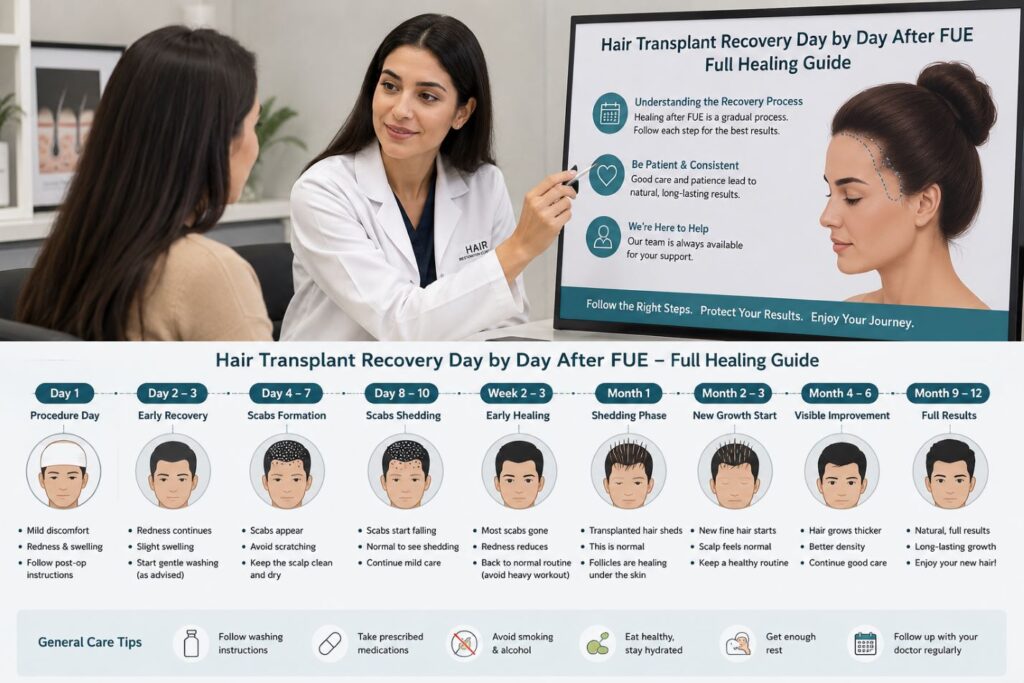
Days 1–3 (Hemostasis & Acute Inflammatory Phase)
During the earliest phase of hair transplant recovery day by day, tiny fibrin clots develop around newly implanted grafts. These clots help stabilize follicular units while microvascular repair begins underneath the skin.
Mild edema near the forehead, erythema, pinpoint bleeding, and scalp tightness usually appear during this stage. Honestly, the scalp can feel strange and sensitive for a few days.
Inflammatory mediators activate tissue repair while donor-area micro-wounds start closing after FUE extraction. At this point, grafts remain highly vulnerable to
- Friction from pillows or hats
- Excess sweating
- Pressure on recipient zones
- Environmental contamination
Patients usually recover more comfortably when they follow careful aftercare routines
- Sleep with the head elevated
- Use a saline spray regularly
- Avoid touching grafts unnecessarily
- Follow controlled cleansing instructions carefully
Days 4–7 (Early Epithelialization Phase)
By this stage of hair transplant recovery day by day, crust formation becomes more visible as epithelialization strengthens the scalp barrier. Revascularization starts surrounding transplanted follicles, helping graft survival improve gradually. Mild itching develops because healing tissue and small nerve endings regenerate together.
Avoid picking scabs, even if they feel irritating. Aggressive scratching may disrupt follicular anchoring. HairBot MD uses ARTAS iX robotic harvesting technology to support precise individual follicular extraction while minimizing linear scarring patterns.
Days 8–14 (Graft Stabilization & Surface Healing)
During hair transplant recovery day by day, recipient sites usually complete epithelial closure around the second week. The scalp often looks cosmetically improved, but biologic recovery still continues beneath the surface.
Early telogen transition may already begin inside transplanted follicles, even though healing appears almost complete.
Most patients can slowly resume office-based work and gentle washing routines during this period, though intense physical activity still needs caution.
Hair Transplant Recovery Day by Day From Shock Loss to Hair Regrowth
One of the most emotionally difficult parts of hair transplant recovery day by day begins after the scalp looks healthier, but the transplanted hairs suddenly start shedding. Many patients panic here because they expect immediate growth once scabs disappear.
Instead, density often decreases for a while. This stage feels frustrating honestly, but it usually reflects normal follicular biology rather than failed graft survival.
Weeks 2–6 (Shock Loss & Telogen Reset)
During this stage of hair transplant recovery day by day, transplanted follicles commonly enter a temporary resting phase called telogen. This process, often called shock loss, happens when cytokine-mediated inflammatory signaling interrupts the active anagen growth cycle after surgical transplantation trauma.
The visible hair shafts shed, but the follicular structures beneath the scalp generally remain viable. In simple words, shedding does not mean graft death. Instead, follicles reset their biologic cycle before future regrowth starts.
Patients may notice
- Mild residual pinkness
- Uneven shedding patterns
- Temporary thin or patchy appearance
- Increased anxiety about density loss
Synchronized telogen entry creates the illusion that results are getting worse before improvement begins. That part scares people sometimes, and understandably so. Hair transplant recovery day by day during this phase requires patience more than anything else.
Months 2–4 (Dormancy & Early Anagen Reactivation)
After shedding stabilizes, hair transplant recovery day by day enters a quieter biological phase. Follicles remain dormant beneath the scalp while stem-cell activation and dermal papilla recovery slowly restart growth signaling pathways.
Blood supply maturation continues around transplanted grafts as perifollicular vascular support improves gradually. When early anagen reactivation finally begins, new hairs usually appear
- Fine in texture
- Hypopigmented
- Low-caliber
- Irregular or uneven in growth direction
This early growth rarely looks dense right away. Some follicles activate earlier than others because follicular cycling does not synchronize perfectly after transplantation.
HairBot MD uses ARTAS iX robotic precision to support controlled follicular harvesting and graft consistency during FUE restoration.
Months 5–12 (Density Maturation Phase)
As hair transplant recovery day by day progresses into later months, cosmetic density gradually improves through ongoing follicular maturation. Hair shafts thicken, pigment normalizes, and texture becomes stronger over time.
Patients usually notice improvements in
- Hair caliber
- Directionality
- Coverage appearance
- Overall fullness and texture
Growth still remains somewhat asynchronous during this phase, so density develops progressively rather than all at once.
Full cosmetic maturation often takes 12–18 months, depending on graft quality, vascular support, scalp healing physiology, and individual biological response. Realistic expectations matter a lot here because long-term hair restoration is gradual, not instant.
“Thinking about FUE but worried about discomfort? Discover what patients actually experience.”
Conclusion – Hair Transplant Recovery Day by Day
Hair transplant recovery day by day involves much more than visible scalp healing. The recovery process moves through several overlapping biologic stages that include inflammation control, vascular repair, follicular dormancy, epithelial restoration, and delayed anagen regeneration.
Many patients expect immediate cosmetic improvement once redness and scabs disappear, but true follicular maturation continues far beneath the skin for many months afterward.
One of the most misunderstood parts of hair transplant recovery day by day is temporary shedding. Shock loss often causes anxiety because density may briefly decrease before regrowth begins.
Still, this shedding usually reflects a normal physiologic follicular reset rather than graft failure. The follicles often remain alive underneath the scalp even when visible hair shafts fall out. That part feels confusing sometimes, honestly, but it’s part of the normal biological timeline after FUE restoration.
Consistent aftercare plays a major role in supporting recovery quality. Proper scalp hygiene, inflammation reduction, controlled washing routines, and protection from friction or contamination help transplanted grafts stabilize more effectively.
At HairBot MD, physician-led ARTAS iX robotic technology supports controlled follicular harvesting precision and natural-looking restoration planning throughout the transplant process.
Most importantly, patients should stay patient with hair transplant recovery day by day because meaningful density develops gradually, not overnight. Hair restoration keeps evolving month after month as follicles mature and strengthen naturally.
Redefine Hair Restoration – Advanced Robotic Transplant Solutions at HairBot MD
Step into the future of hair restoration with HairBot MD, your trusted destination for precision-driven robotic hair transplant technology. Our state-of-the-art platform combines cutting-edge robotics with expert medical oversight to deliver natural-looking results with unmatched accuracy and efficiency.
At HairBot MD, we specialize in robotic FUE transplants using systems like ARTAS®, offering minimally invasive procedures, faster recovery, and customized treatment planning. Whether you’re experiencing early-stage hair loss or seeking full restoration, our solutions are designed to meet your unique goals with confidence.
Explore our full range of services and discover how we blend science and artistry to deliver exceptional results. Visit our Home, learn more about our approach, or Contact us to speak with a specialist. Ready to take the first step? Get a Free Assessment today and start your journey to hair confidence.
📍 HairBot MD – Your Destination for Robotic Hair Transplant in Cypress, TX
Looking for the most advanced hair restoration solution near you? HairBot MD specializes in robotic hair transplants using the FDA-cleared ARTAS iX system, delivering precision, speed, and natural results.
✅ Address: 17110 House & Hahl Rd, B-2, Cypress, TX 77433
📞 Call Us: (346) 472-2353
✨ Claim Your Free HairBot MD Assessment!
Whether you’re curious about the ARTAS iX robotic system or ready to schedule a free consultation, our expert team is here to guide you through every step of your hair restoration journey.