
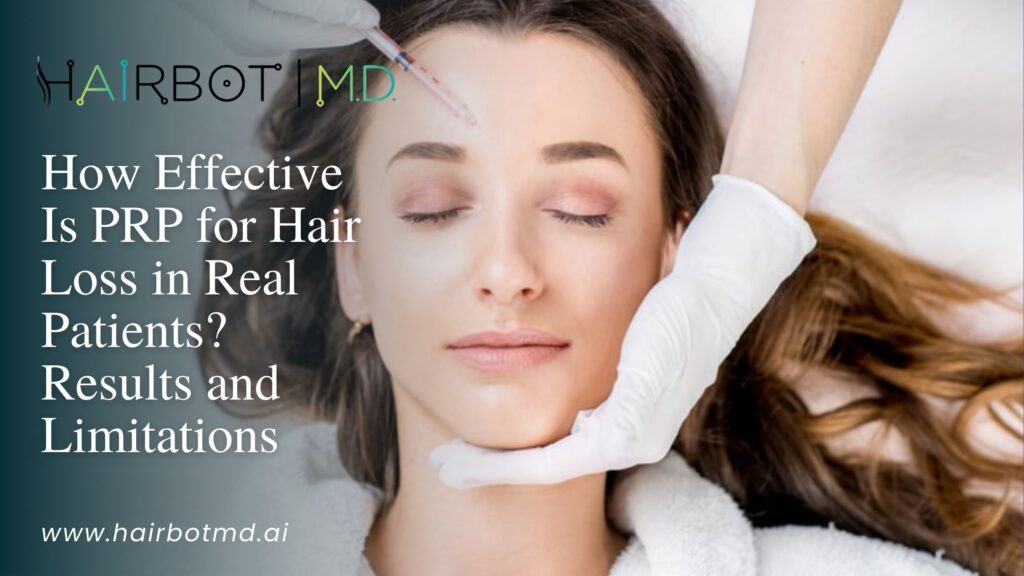
How effective is PRP for hair loss? It’s the question people ask the moment thinning stops feeling cosmetic and starts feeling medical. When the part widens, shedding accelerates, or early bald spots catch the light in every photo, PRP becomes the therapy everyone whispers about, but few actually understand.
PRP is an autologous, growth-factor–based regenerative treatment that uses concentrated platelets from your own blood to stimulate miniaturized follicles affected by androgenetic alopecia and other non-scarring alopecias.
In clinical practice, PRP stays minimally invasive and entirely in-office. Dermatologists inject it intradermally or subdermally across thinning zones, often pairing it with microneedling to amplify growth-factor release.
The science is real, but the regulatory landscape matters: although PRP devices hold FDA clearance for orthopedic and wound-healing uses, PRP for hair loss remains off-label. That requires honest counseling, clear expectations, and a plan tailored to each patient’s biology.
And that brings us back to the central question: how effective is PRP for hair loss? The answer depends on platelet dose, disease stage, follicle viability, and how consistently sessions are performed. It delivers probable improvement, not guaranteed regrowth.
HairBot MD closes the gap by letting patients and dermatologists track shedding, photos, treatment dates, and side effects to see whether PRP is truly working over time.
How Effective Is PRP for Hair Loss? Mechanisms, Clinical Data, and Timelines
How Effective Is PRP for Hair Loss at the Follicular and Molecular Level?
PRP concentrates platelets to roughly two to seven times baseline, often targeting around 1.0–1.5 million per microliter. That higher platelet dose delivers a dense “payload” of growth factors directly into androgen-dependent, miniaturizing scalp regions.
Core growth factors in PRP include
- PDGF and FGF drive dermal papilla proliferation and extracellular matrix synthesis in the follicular niche.
- VEGF, which promotes angiogenesis and better perifollicular microcirculation around struggling follicles.
- EGF, IGF-1, and TGF-β modulate anagen duration and keratinocyte behavior in complex, sometimes overlapping ways.
These signals activate intracellular pathways your team already knows well. ERK and Akt signaling ramp up survival programs and reduce apoptosis in compromised follicles.
β-catenin increases within the follicular environment and supports hair matrix activity and follicle cycling stability. Ki67+ keratinocytes rise in number, reflecting higher proliferative activity in the bulge and matrix zones.
PRP classification systems explain some variability you see clinically. P-PRP contains fewer leukocytes and typically less inflammatory load than L-PRP preparations. The DEPA framework forces you to consider dose, efficiency, purity, and activation rather than just “we did PRP.”
Differences in single versus double spin, activators like calcium chloride, and leukocyte content change biological behavior significantly.
How Effective Is PRP for Hair Loss in Clinical Trials and Real-World Cohorts?
Evidence in androgenetic alopecia is cautiously encouraging, not absolute. One key review reported seven of nine controlled studies showing improvements in density and thickness. Neutral trials usually involved suboptimal platelet dosing, unclear activation, or underpowered designs.
Objective endpoints commonly include:
- Hair count per square centimeter on standardized trichoscopy.
- Global hair density and shaft diameter metrics over target regions.
- Anagen to telogen ratio shifts after induction and maintenance phases.
- Patient-reported satisfaction and perceived ease of daily styling.
Response heterogeneity is real in daily practice. Variables include platelet dose, injection pattern, depth, session number, and disease duration. Early androgenetic alopecia typically responds better than long-standing, fibrotic miniaturization.
A practical way to frame things for patients is simple.
- Many show meaningful improvement in coverage or shedding control.
- Some show stabilization more than visible regrowth.
- A subset shows minimal or no response, even with sound protocols.
HairBot MD helps clinicians move beyond vague impressions. You can anchor the question “How effective is PRP for hair loss?” to numbers, images, and timelines instead of memory alone.
How Effective Is PRP for Hair Loss Over 1–3, 3–6, and 6–12 Months?
Timelines matter when you interpret a response. Nothing meaningful happens in two weeks, and patients often expect that.
Typical patterns look like this
- 1–3 months: Shedding often decreases; texture and “grip” may feel slightly better during styling.
- 3–6 months: Responders usually show denser coverage, thicker shafts, and improved photogrammetry over target zones.
- 6–12 months: Gains plateau; without maintenance, metrics and photos often drift gradually back toward baseline.
So effectiveness always lives on a months-long horizon, never days. That is why structured tracking becomes part of the treatment, not an afterthought.
With HairBot MD, you can
- Capture pre-treatment baselines with standardized angles and lighting.
- Schedule post-session check-ins at Week 6, Month 3, and Month 6.
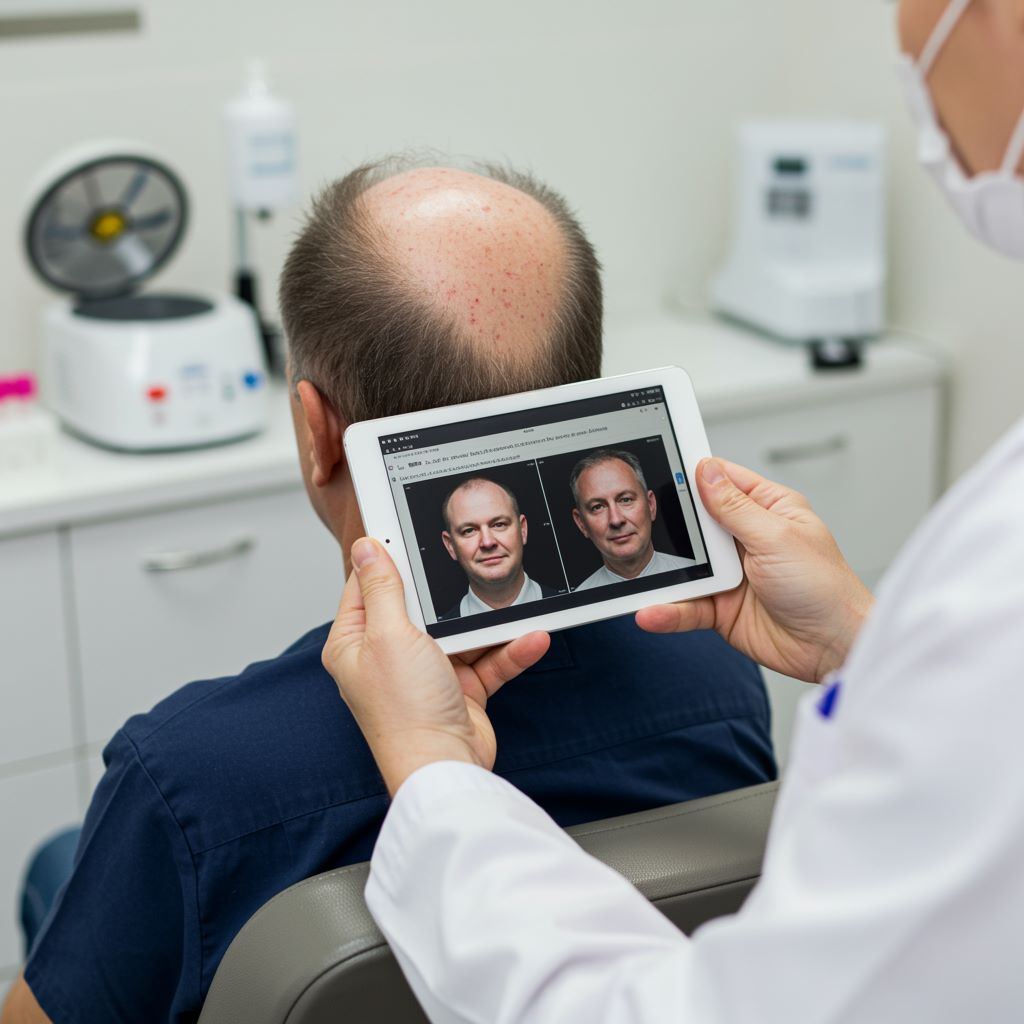
- Compare side-by-side series to judge whether PRP is delivering enough benefit to justify continued sessions.
In the end, effectiveness stops being theoretical. It shows up as measured changes in density, shedding patterns, and real-world styling, or it does not.
Ready to reclaim your hair naturally? Book your free assessment at HairBot MD now and discover the advanced hair growth treatment crafted just for you.
How Effective Is PRP for Hair Loss When You Factor in Safety and Combination Therapy?
How Effective Is PRP for Hair Loss When You Balance Efficacy and Safety?
PRP uses autologous platelets, so immunologic risk stays very low in competent hands. You are not importing foreign proteins or donor cells here.
Typical, self-limited reactions include
- Local injection pain and transient scalp tightness after the session.
- Mild edema, erythema, and small bruises along the treated grid zones.
- Short-lived headache or pressure sensation after extensive coverage work.
- Occasional telogen effluvium spike as follicles reset into a new anagen wave.
Serious events remain rare but still matter.
- Infection usually signals poor asepsis or missed scalp disease.
- Nodules or scarring often follow an overly aggressive technique or the wrong depth.
- Nerve irritation appears when anatomical planes are ignored.
So, how effective is PRP for hair loss? should always sit beside “How safe is this implementation?” You want hair-focused clinics, strict protocolization, and proper documentation. HairBot MD helps by logging adverse events, timing, and resolution in structured timelines.
How Effective Is PRP for Hair Loss in the Right Candidates vs the Wrong Ones?
Candidate selection quietly decides most outcomes before the centrifuge spins.
Ideal profiles usually include
- Men or women with Hamilton–Norwood II–IV or Ludwig I–III patterns.
- Diffuse thinning with viable follicles, not polished, scarred scalp.
- Patients are already optimized on minoxidil, finasteride, spironolactone, or LLLT.
Poor candidates often look different.
- Advanced alopecia with extensive miniaturization or clear fibrosis on trichoscopy.
- Active infections, severe dermatitis, psoriasis, or suspected scalp malignancy.
- Platelet dysfunction, severe anemia, uncontrolled diabetes, or strong immunosuppression.
In those settings, how effective is PRP for hair loss? Trends toward negligible. You cannot resurrect follicles that no longer exist or override unstable systemic disease.
HairBot MD can streamline pre-visit triage.
- Capture family history, onset pattern, and major triggers like pregnancy or surgery.
- Record current medications and previous responses or failures.
Dermatologists then decide whether PRP is a rational next step or a distraction.
How Effective Is PRP for Hair Loss When Combined With Other Therapies?
PRP works as a co-adjuvant, not a hormonal blocker. It does not reduce DHT; it remodels the local regenerative microenvironment.
Synergy often matters more than single agents.
- With minoxidil or finasteride, PRP can accelerate visible gains in partial responders.
- With LLLT, overlapping effects support microcirculation and mitochondrial function.
- In hair transplantation, PRP may enhance graft take and donor healing speed.
Here, how effective is PRP for hair loss? Becomes a question about the whole stack. Results reflect the combined protocol, not PRP in isolation.
HairBot MD acts as your “hair health logbook.”
- Track adherence to oral, topical, device, and procedural elements together.
- Link PRP session dates to density metrics, shedding scores, and styling feedback.
When curves plateau, you and your dermatologist can decide to continue, pause, or pivot intelligently.
How Effective Is PRP for Hair Loss? Conclusion and Next Steps
How effective is PRP for hair loss? Ultimately depends on your follicles, your protocol, and your expectations, not online hype. PRP is biologically plausible and minimally invasive, but it is not magic, not permanent, and not a stand-alone cure.
For most responders, gains arrive slowly and then plateau. You see changes over months, not weeks, and only with repeat sessions. When you stop treatment, the benefits usually drift back toward your genetic baseline over time.
Real success comes when PRP sits inside a full medical plan. That means hormones addressed, nutrition optimized, scalp inflammation controlled, and triggers like stress or postpartum shifts managed.
Think of PRP as a targeted boost to miniaturizing follicles, while other therapies stabilize the underlying disease process. HairBot MD helps you treat this like data, not vibes. You log shedding scores, standardized photos, session dates, and concurrent medications in one place.
Your dermatologist then reviews objective trajectories instead of relying on vague memory or “I think it’s better.” With that structure, you can honestly answer, How effective is PRP for hair loss for me personally? And then decide, with your clinician, whether to double down, adjust the protocol, or pivot to different strategies.
Redefine Hair Restoration – Advanced Robotic Transplant Solutions at HairBot MD
Step into the future of hair restoration with HairBot MD, your trusted destination for precision-driven robotic hair transplant technology. Our state-of-the-art platform combines cutting-edge robotics with expert medical oversight to deliver natural-looking results with unmatched accuracy and efficiency.
At HairBot MD, we specialize in robotic FUE transplants using systems like ARTAS®, offering minimally invasive procedures, faster recovery, and customized treatment planning. Whether you’re experiencing early-stage hair loss or seeking full restoration, our solutions are designed to meet your unique goals with confidence.
Explore our full range of services and discover how we blend science and artistry to deliver exceptional results. Visit our Home, learn more about our approach, or Contact us to speak with a specialist. Ready to take the first step? Get a Free Assessment today and start your journey to hair confidence.
📍 HairBot MD – Your Destination for Robotic Hair Transplant in Cypress, TX
Looking for the most advanced hair restoration solution near you? HairBot MD specializes in robotic hair transplants using the FDA-cleared ARTAS iX system, delivering precision, speed, and natural results.
✅ Address: 17110 House & Hahl Rd, B-2, Cypress, TX 77433
📞 Call Us: (346) 472-2353
✨ Claim Your Free HairBot MD Assessment!
Whether you’re curious about the ARTAS iX robotic system or ready to schedule a free consultation, our expert team is here to guide you through every step of your hair restoration journey.