
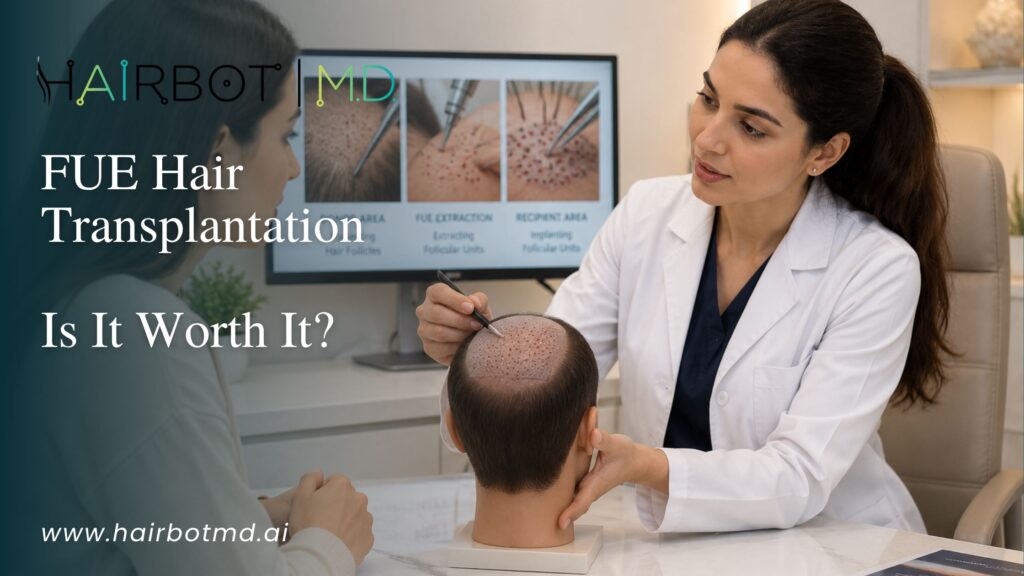
FUE hair transplantation has completely changed the way people think about hair restoration, especially for patients tired of wasting money on temporary fixes that never truly solve thinning hair.
Hair fibers wash away, medications often require lifelong use, and many non-surgical treatments only slow hair loss instead of restoring density. That’s exactly why more patients are now turning toward FUE hair transplantation as a long-term solution designed to rebuild natural hair growth using their own healthy follicles.
Unlike older methods that focused mainly on cosmetic coverage, modern FUE hair transplantation works as a biological follicular restoration procedure.
Individual follicular units are carefully harvested from genetically stable donor areas and transplanted into thinning regions with the goal of creating permanent, natural-looking growth.
The evolution of robotic technology, especially systems like ARTAS iX, has further improved the precision and consistency of FUE hair transplantation by helping physicians select grafts more accurately while reducing unnecessary donor trauma and visible scarring.
Still, many patients continue asking the same question: is FUE hair transplantation really worth the cost, recovery process, and long-term commitment? This guide explores FUE hair transplantation from every angle, including medical science, cosmetic outcomes, recovery expectations, financial value, and long-term results.
At HairBot MD, the focus remains on physician-led planning combined with advanced robotic precision to create individualized and natural-looking restoration strategies.
FUE Hair Transplantation and the Science Behind Long-Term Hair Restoration
How FUE Hair Transplantation Works Biologically
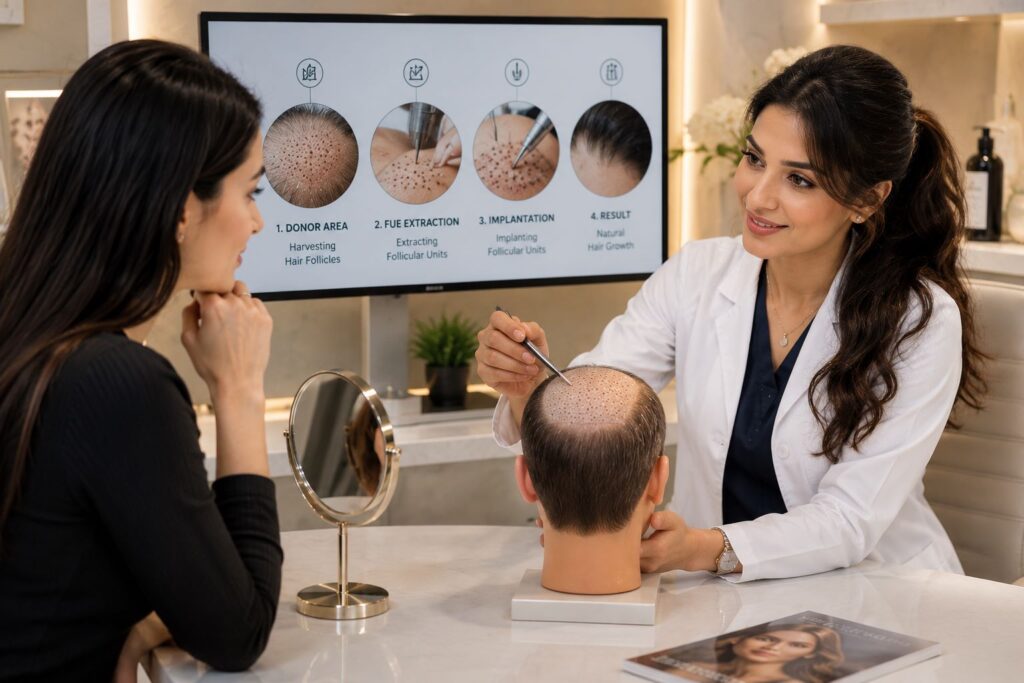
FUE hair transplantation works by removing individual follicular units from genetically stable donor areas, usually the back and sides of the scalp, and relocating them into thinning regions.
Unlike older strip procedures, FUE hair transplantation extracts follicles one by one using tiny circular punches, which helps avoid a long linear scar and supports faster healing.
The science behind FUE hair transplantation largely depends on the donor dominance theory. Hair follicles taken from resistant donor zones usually keep their genetic resistance even after surgeons transplant them into balding areas. That’s why transplanted hairs often continue growing for years.
During FUE hair transplantation, several biological steps happen together
- Precise graft harvesting
- Recipient site creation
- Follicular implantation
- Vascular reconnection beneath the scalp
- Dermal anchoring and tissue healing
Blood supply restoration becomes extremely important because newly implanted grafts survive through rapid oxygen and nutrient exchange. Honestly, the first few days matter a lot more than most patients realize.
Modern robotic systems like ARTAS iX have improved FUE hair transplantation by helping physicians identify stronger grafts with more consistency.
Robotic precision also helps reduce follicular transection, which means fewer follicles become damaged during extraction. Lower transection rates usually support better long-term density and donor preservation.
FUE Hair Transplantation vs Temporary Hair Loss Treatments
Many patients compare FUE hair transplantation with temporary hair loss solutions before making a decision. Non-surgical treatments can help slow progression, but they usually do not permanently restore density.
Common options include
- PRP therapy for follicular stimulation
- Minoxidil for growth support
- Oral medications for DHT suppression
- Hair fibers for cosmetic concealment
FUE hair transplantation differs because it redistributes permanent follicles instead of temporarily masking hair loss. Patients with stable donor density, realistic expectations, and progressive thinning often benefit most from surgery.
The Recovery Reality of FUE Hair Transplantation
Recovery after FUE hair transplantation happens in phases, not all at once. Patients often panic during shock loss because transplanted hairs temporarily shed before entering telogen dormancy. This stage feels scary sometimes, but the follicles usually remain alive underneath the scalp.
Typical recovery phases include the following:
- Inflammation and redness
- Epithelialization and scab resolution
- Shock loss
- Dormancy
- Early anagen regrowth
- Hair maturation from months 3–12
Visible healing appears much earlier than true follicular maturation. New hairs often start thin, soft, uneven, and lightly pigmented before density gradually improves over time.
Is FUE Hair Transplantation Worth It Financially and Cosmetically?
The Long-Term Value of FUE Hair Transplantation
Many patients pause before choosing FUE hair transplantation because the upfront price feels higher than temporary hair loss solutions. But after some years, the math usually changes fast.
People keep spending money every month on topical products, medications, shampoos, PRP sessions, hair fibers, and cosmetic cover-ups without even noticing how much disappears over time. Honestly, lots of patients later realize they spent thousands and still never achieved lasting density improvement.
FUE hair transplantation works in a very different way because it redistributes genetically resistant follicles into thinning areas for long-term restoration.
Once transplanted follicles reconnect with the blood supply and settle into stable growth cycles, they usually continue growing naturally for years and years. That’s really the part many people underestimate at first.
Long-term value often comes from
- Permanent follicular redistribution
- Less dependence on cosmetic concealment
- More natural density improvement
- Lower long-term maintenance costs
- Better confidence during daily life
Still, maintenance matters after FUE hair transplantation. Some patients continue PRP or medications to help protect nearby native hair from future thinning.
Donor preservation becomes extremely important, too, especially for younger patients dealing with progressive androgenetic alopecia. Smart planning now can keep future restoration options open later if hair loss keeps progressing.
Cosmetic Benefits of FUE Hair Transplantation
The cosmetic benefits from FUE hair transplantation usually go way beyond simple hair coverage. A properly designed hairline can completely reshape facial framing and improve overall appearance. Even moderate density changes often make patients look younger, fresher, and honestly more energized.
Patients often choose FUE hair transplantation because of benefits like
- No long linear scar compared to FUT
- Freedom to wear shorter hairstyles
- Faster healing and recovery
- More natural hairline customization
- Less invasive donor harvesting
- Better styling flexibility
For many patients, confidence improvements become just as important as the actual hair growth itself. Some start feeling comfortable in social settings again, while others gain confidence during meetings, photoshoots, work events, or daily conversations. Hair loss affects self-image deeper than many people admit sometimes; it really does.
Risks and Limitations of FUE Hair Transplantation
Not every patient becomes an ideal candidate for FUE hair transplantation. Results depend heavily on donor quality, scalp condition, hair caliber, and realistic expectations.
Possible limitations may include the following:
- Poor donor density
- Advanced baldness patterns
- Aggressive ongoing hair loss
- Unrealistic cosmetic goals
Recovery-related issues may include
- Temporary redness
- Shock loss
- Folliculitis
- Uneven early growth phases
Visible growth after FUE hair transplantation also requires patience. Early hairs often appear thin, soft, patchy, or lightly pigmented before stronger maturation develops between months 6–12.
Is Robotic FUE Hair Transplantation Better?
Modern robotic systems like ARTAS iX have improved FUE hair transplantation by creating more harvesting consistency and reducing unnecessary donor trauma. Robotic-assisted extraction helps reduce overharvesting while supporting more accurate graft selection too.
Important robotic benefits include
- Consistent graft harvesting patterns
- Reduced follicular transection risk
- Better donor preservation
- Improved extraction precision
- Faster procedural efficiency
Still, technology alone does not create natural-looking results. Physician planning, artistic hairline design, graft placement angles, and long-term strategy still matter heavily during FUE hair transplantation.
At HairBot MD, robotic precision combines with physician oversight to support individualized and natural-looking restoration outcomes.
“Unsure if ARTAS iX fits your goals and budget? Read our full breakdown now!”
Final Thoughts on FUE Hair Transplantation
FUE hair transplantation offers far more than temporary cosmetic coverage because it restores actively growing follicles using permanent donor hair taken from genetically stable areas of the scalp.
Unlike short-term concealment products or repetitive treatments that mainly slow progression, FUE hair transplantation focuses on rebuilding natural density through long-term follicular restoration. That’s why many patients eventually see it as an investment in both appearance and confidence, not just hair alone.
Successful FUE hair transplantation depends on several important factors working together at the same time. Proper candidate selection, careful donor management, surgical precision, realistic expectations, and long-term scalp health all influence final outcomes.
Even advanced robotic systems still rely heavily on physician planning and artistic judgment to create natural-looking density and balanced hairline design.
Many patients judge FUE hair transplantation too early during the shedding and dormancy stages. Honestly, this becomes one of the most misunderstood parts of recovery.
The scalp may look healed within weeks, but biologic follicular recovery continues quietly underneath the skin for months. Temporary shedding does not usually mean graft failure, even if the early phases feel discouraging sometimes.
Over time, transplanted follicles gradually mature, thicken, and improve in texture between months 3–12. When performed by experienced physician-led clinics like HairBot MD, modern robotic-assisted FUE hair transplantation can provide natural-looking, minimally invasive, and long-lasting restoration results.
Redefine Hair Restoration – Advanced Robotic Transplant Solutions at HairBot MD
Step into the future of hair restoration with HairBot MD, your trusted destination for precision-driven robotic hair transplant technology. Our state-of-the-art platform combines cutting-edge robotics with expert medical oversight to deliver natural-looking results with unmatched accuracy and efficiency.
At HairBot MD, we specialize in robotic FUE transplants using systems like ARTAS®, offering minimally invasive procedures, faster recovery, and customized treatment planning. Whether you’re experiencing early-stage hair loss or seeking full restoration, our solutions are designed to meet your unique goals with confidence.
Explore our full range of services and discover how we blend science and artistry to deliver exceptional results. Visit our Home, learn more about our approach, or Contact us to speak with a specialist. Ready to take the first step? Get a Free Assessment today and start your journey to hair confidence.
📍 HairBot MD – Your Destination for Robotic Hair Transplant in Cypress, TX
Looking for the most advanced hair restoration solution near you? HairBot MD specializes in robotic hair transplants using the FDA-cleared ARTAS iX system, delivering precision, speed, and natural results.
✅ Address: 17110 House & Hahl Rd, B-2, Cypress, TX 77433
📞 Call Us: (346) 472-2353
✨ Claim Your Free HairBot MD Assessment!
Whether you’re curious about the ARTAS iX robotic system or ready to schedule a free consultation, our expert team is here to guide you through every step of your hair restoration journey.