 Private Hair Restoration - Cypress, Texas
The technology is impressive. The judgment still matters more.
By the time most people start looking at robotic hair restoration, they have already spent years noticing the same changes in photos, mirrors, and certain lighting. ARTAS iX brings precision to the technical parts of FUE: mapping, selecting, harvesting, recipient site creation, and implantation support. The deeper question is whether the plan will still look like you later.
Where the machine helps.
ARTAS iX uses AI-guided follicle selection, robotic harvesting, recipient site creation, and implantation support with custom angles, spacing, and density. It is designed to bring more control to the technical parts of FUE without the long linear scar associated with strip surgery.
The part worth slowing down for is judgment. Advanced technology can still be used to sell too many grafts, chase speed, or ignore the design and donor-management decisions that make a result look natural.
The honest version of robotic hair restoration.
The science behind the restraint.
ARTAS iX uses stereoscopic imaging and software to evaluate follicle direction, angle, density, and donor-area patterns in real time.
The robotic arm is designed for repeatable movement during long, detail-heavy steps where human fatigue can matter.
ARTAS workflows can support recipient site creation and implantation planning so angle, spacing, depth, and distribution are not treated casually.
What the mapping actually measures.
Before anything is harvested, the system builds a three-dimensional map of the donor area and evaluates each follicular unit against a set of measurable criteria rather than an impression.
- Angle and direction. Follicles are assessed for their natural exit angle so extraction follows the way the hair already grows rather than cutting across it.
- Depth. Punch depth is calibrated per unit, which is what separates a clean follicular unit from a damaged one.
- Density distribution. The donor area is read as a whole, so harvesting is spread rather than concentrated in one region.
- Graft viability. Units are evaluated for diameter and structure before they are selected, and imaging updates continuously during the session.
The practical value is consistency across a long session. A person's attention drifts over several hours; the measurement does not. That is a real advantage, and it is also the limit of what the machine contributes — it measures well, and it does not decide what the result should look like.
What the robotic workflow can support.
Precision is visible. Judgment is quieter.
The scan, robotic arm, and planning screen make the process feel more controlled. That matters when the thing you want most is not a dramatic change, but a result no one has to study.
What matters next is less visible: which grafts to take, where not to overdo it, how the hairline should age, and whether surgery is even the right first move.
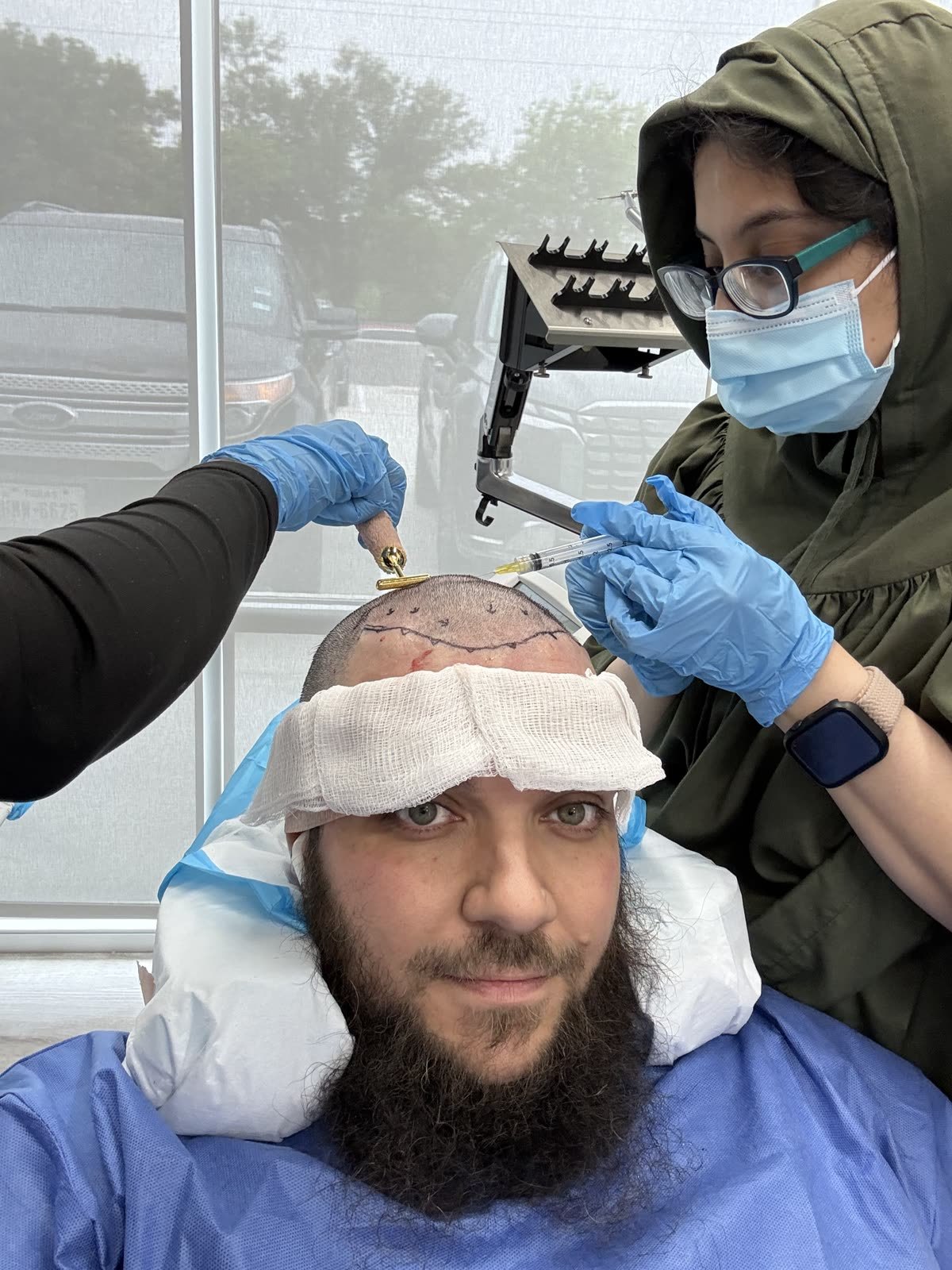
Why Dr. B's training matters here.
Dr. B completed a clinical hair restoration preceptorship with Dr. Miguel Canales and Venus for hands-on robotic FUE and ARTAS training. That connection matters because the strongest version of ARTAS is not robot instead of physician. It is robot plus physician judgment: precision used with restraint, timing, donor protection, and a hairline that can age well.
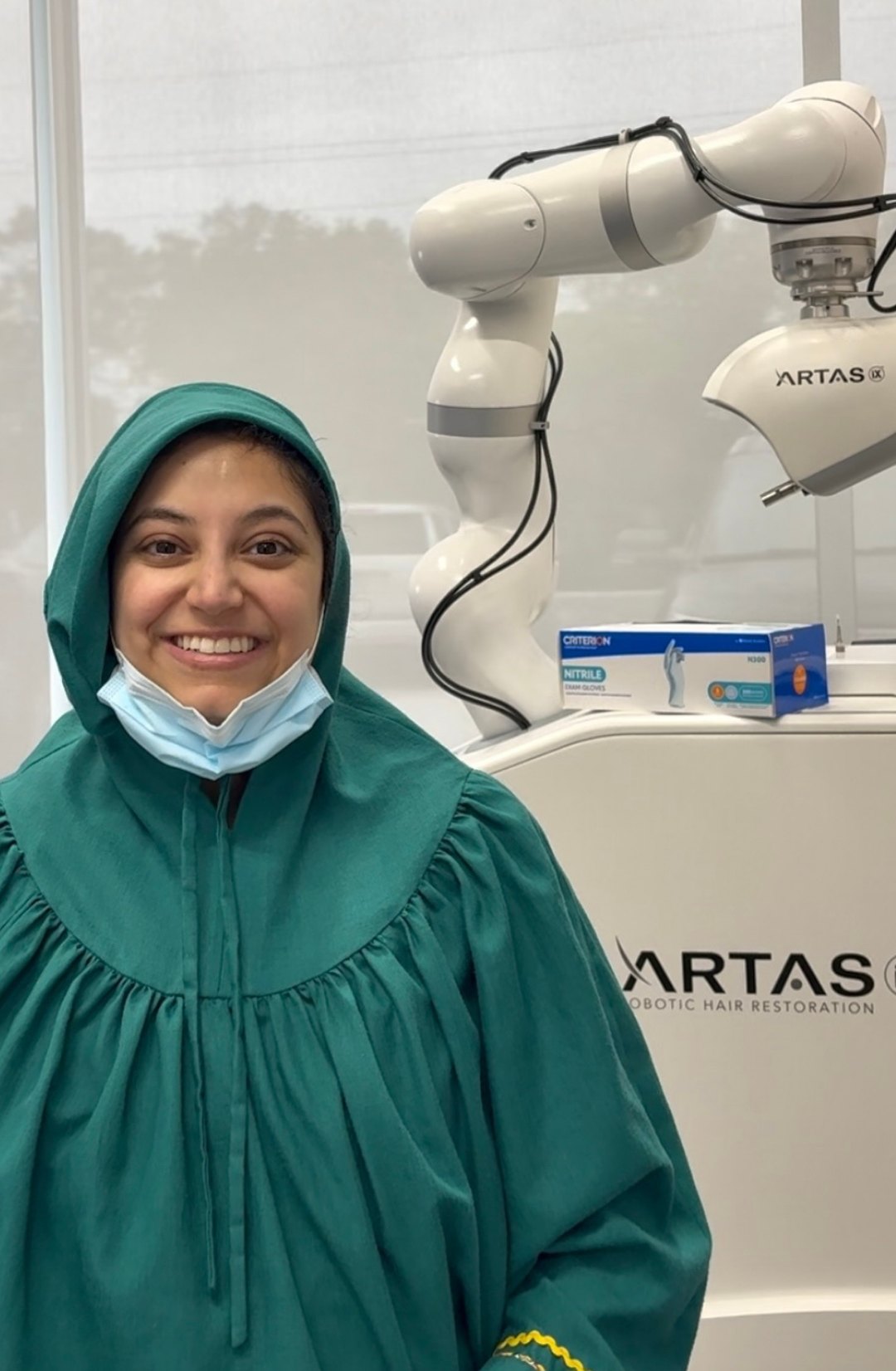
Is robotic FUE the right option?
Robotic FUE may be part of the answer. The first question is quieter: what are you trying to correct, what are you trying to avoid, and how private does the process need to feel while you decide?
Who robotic FUE tends to read well for.
Candidacy is a clinical judgement, not a checklist, but a few things make the technical side more straightforward:
- A stable donor area. Enough density in the permanent zone, with a pattern that has settled rather than one still actively changing.
- Predictable growth direction. Straight and gently wavy hair maps more cleanly than tight curl, where follicles curve beneath the surface.
- Realistic scope. A plan sized to what the donor area can support long term, not to what could be harvested in one session.
None of that settles whether surgery is the right first move. Medication history, age, rate of loss, and what the pattern is likely to do over the next decade matter more than whether a scalp maps well.
What the timeline actually looks like.
Hair restoration is slower than most people expect, and knowing that in advance prevents a lot of unnecessary worry in month two.
Shedding of the transplanted hair within the first weeks is expected and is not a sign that the graft failed. The follicle stays; the shaft cycles.
Across HairBotMD's own patients, graft survival has run above 90% at six to twelve months, with even regrowth patterns.
If you are weighing whether this is worth doing, the other half of the decision is what a robotic hair transplant costs.
What FUE does to the donor area.
Robotic FUE leaves no linear scar. There is no strip of scalp removed and nothing to close, which is the difference people are usually asking about when they ask about scarring.
What extraction does leave are individual punch sites, roughly a millimetre across, dispersed across the donor area rather than concentrated in one line. They heal as small pale dots. At conventional haircut lengths — including short ones — they are typically not visible, which is why FUE suits people who wear their hair short and did not want that decision made for them by a scar.
Spreading extraction across the donor area, rather than harvesting heavily from one region, is part of what keeps that true. It is one of the places where the mapping earns its keep.